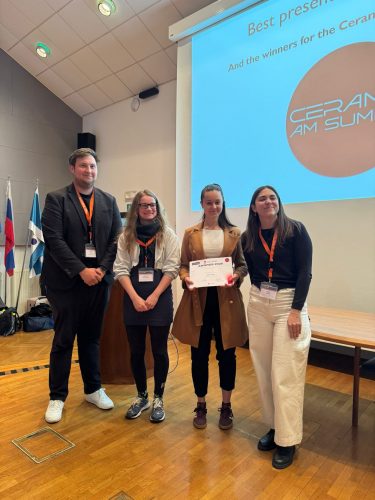
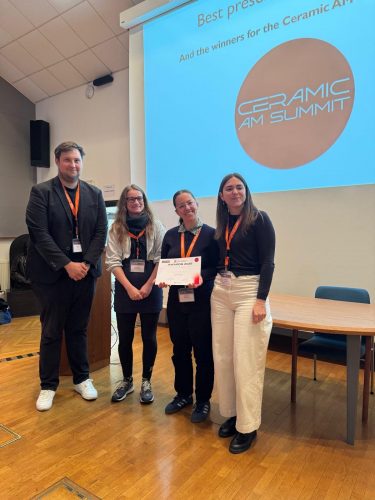
The young Ceramists Additive Manufacturing Forum (yCAM) 2026 took place at Jožef Stefan Institute, from 11th to 13th of May 2026. During yCAM, 3DCERAM Award for Best Speaker was won by Dr. Ipeknaz Özden Moser from Department for Nanostructured Materials (K7), for her talk on “Ceramic additive manufacturing by micron sized droplet jetting of thermoplastic feedstocks”. 3DCERAM Award for Best Poster was won by Pia Popovič, also from Department for Nanostructured Materials (K7), for her poster on “Thermoplastic material jetting of paraffin-wax-based alumina suspensions”. With these awards, they received the chance to present their work at the 2026 Ceramic AM Summit which will be held from 29th of June to 1st of July in Freiburg, Germany, as well as registration and travel grants for this event. Congratulations to both, as well as their supervisors Assoc. Prof. Dr. Andraž Kocjan and Dr. Aljaž Iveković.
Vinko Longar, Rudolfovo, Institut Jožef Stefan, MPŠ
Thursday, 9. 4. 2026 at 13:20, at the MPŠ lecture room
Abstract:
TiO₂ nanotube catalyst development is limited by the complexity of its main synthesis route, the anodic
oxidation, which presents a large number of interacting synthesis parameters, and slow connection between
synthesis, characterization, and application testing. This seminar examines how digital transformation, machine
learning, and autonomous experimentation can accelerate this process by converting the workflow into
a structured, data rich, and machine readable system. The proposed approach follows a staged progression
from anodic oxidation, to electrochemical characterization, and finally to degradation experiments
with UPLC analysis. A transfer learning pipeline is suggested to connect these stages, enabling knowledge
to be transferred from synthesis data to characterization and then to application performance.
The main conclusion is that the immediate priority is to build reproducible and traceable workflows that can
support future closed loop autonomous discovery of TiO ₂ nanotube catalysts.
Aleksander Učakar, Institut Jožef Stefan
Thursday, 26. 03. 2026 at 13:00, at the Kolar lecture hall
Abstract:
The phase composition and microstructure of strontium hexaferrite (SFO) ceramics critically determine their hard magnetic properties In this study, SFO was rapidly densified by pressureless spark plasma sintering (pSPS) at a heating rate of 500 C min⁻¹ using a radiative graphite crucible. Under these conditions, partial decomposition of the material occurred, yielding Sr rich and Sr deficient phases with distinct morphologies that together diminished the magnetic hardness. Several secondary phases possessed lower melting temperatures, resulting in localized liquid formation and a transition from purely solid state densification to a combined solid liquid mechanism. To contextualize these findings, the microstructures produced by pSPS were compared with those obtained by conventional sintering under various atmospheric conditions, highlighting the influence of the processing atmosphere on phase stability and microstructural evolution in SFO.
22. 01. 2026, ob 13:00 v Kolarjevi predavalnici
Barbara Ljubec B., Institut Jožef Stefan
Tuesday, 20. 01. 2026 at 13:00, at the Kolar lecture hall
Abstract:
What if hydrogen evolution catalysts could be designed without relying on scarce and expensive noble metals? Entropy stabilized alloys (ESA) offer a promising pathway toward this goal. By combining multiple transition metals into a single and entropy stabilized structure, ESA enable new strategies for tuning catalytic activity and stability in the hydrogen evolution reaction (HER).
In this seminar, I will present our work on the synthesis, physicochemical characterization, and electrocatalytic evaluation of various Cantor type ESAs (CoFeNi, CoFeNiMn, CoFeNiCr and CoFeNiMnCr) for the HER in both alkaline and acidic Environments. The seminar will systematically explore the relationships between physicochemical properties (such as chemical composition, phase structure, and microstructure) and electrocatalytic activity and stability toward HER. The presented results will demonstrate how compositional disorder, when guided by entropy stabilization, can be transformed into a rational design strategy for realistic next generation HER electrocatalysts.
Belisa Alcantara Marinho, Institut Jožef Stefan
Thursday, 15. 01. 2026 at 12:00, at the Kolar lecture hall, JSI
Abstract:
During the last decades, great efforts have been undertaken to improve the activity and durability of catalysts in diverse fields of application. Since for each type of reaction certain catalysts are more effective than others, it is critical to identify and understand those features serving as active sites, and how to tune these features for maximum performance. Much has been done to understand these parameters on single metal, metal oxide, and doped metal oxide catalysts, but improved materials are still urgently needed. The raise of a new category of complex high entropy materials (HEMs) including high entropy alloys (HEAs) and high entropy oxides (HEOs) shows great potential to become the next generation of high performance catalysts as they have already been reported to present high catalytic activity. In this lecture, the main findings observed in the synthesis and applications in different (photo)(electro)catalytic processes will be presented and discussed along with the next steps to better understand the potential of this class of materials in the catalysis field.