Vinko Longar, Rudolfovo, Institut Jožef Stefan, MPŠ
Thursday, 9. 4. 2026 at 13:20, at the MPŠ lecture room
Abstract:
TiO₂ nanotube catalyst development is limited by the complexity of its main synthesis route, the anodic
oxidation, which presents a large number of interacting synthesis parameters, and slow connection between
synthesis, characterization, and application testing. This seminar examines how digital transformation, machine
learning, and autonomous experimentation can accelerate this process by converting the workflow into
a structured, data rich, and machine readable system. The proposed approach follows a staged progression
from anodic oxidation, to electrochemical characterization, and finally to degradation experiments
with UPLC analysis. A transfer learning pipeline is suggested to connect these stages, enabling knowledge
to be transferred from synthesis data to characterization and then to application performance.
The main conclusion is that the immediate priority is to build reproducible and traceable workflows that can
support future closed loop autonomous discovery of TiO ₂ nanotube catalysts.
Aleksander Učakar, Institut Jožef Stefan
Thursday, 26. 03. 2026 at 13:00, at the Kolar lecture hall
Abstract:
The phase composition and microstructure of strontium hexaferrite (SFO) ceramics critically determine their hard magnetic properties In this study, SFO was rapidly densified by pressureless spark plasma sintering (pSPS) at a heating rate of 500 C min⁻¹ using a radiative graphite crucible. Under these conditions, partial decomposition of the material occurred, yielding Sr rich and Sr deficient phases with distinct morphologies that together diminished the magnetic hardness. Several secondary phases possessed lower melting temperatures, resulting in localized liquid formation and a transition from purely solid state densification to a combined solid liquid mechanism. To contextualize these findings, the microstructures produced by pSPS were compared with those obtained by conventional sintering under various atmospheric conditions, highlighting the influence of the processing atmosphere on phase stability and microstructural evolution in SFO.
22. 01. 2026, ob 13:00 v Kolarjevi predavalnici
Barbara Ljubec B., Institut Jožef Stefan
Tuesday, 20. 01. 2026 at 13:00, at the Kolar lecture hall
Abstract:
What if hydrogen evolution catalysts could be designed without relying on scarce and expensive noble metals? Entropy stabilized alloys (ESA) offer a promising pathway toward this goal. By combining multiple transition metals into a single and entropy stabilized structure, ESA enable new strategies for tuning catalytic activity and stability in the hydrogen evolution reaction (HER).
In this seminar, I will present our work on the synthesis, physicochemical characterization, and electrocatalytic evaluation of various Cantor type ESAs (CoFeNi, CoFeNiMn, CoFeNiCr and CoFeNiMnCr) for the HER in both alkaline and acidic Environments. The seminar will systematically explore the relationships between physicochemical properties (such as chemical composition, phase structure, and microstructure) and electrocatalytic activity and stability toward HER. The presented results will demonstrate how compositional disorder, when guided by entropy stabilization, can be transformed into a rational design strategy for realistic next generation HER electrocatalysts.
Belisa Alcantara Marinho, Institut Jožef Stefan
Thursday, 15. 01. 2026 at 12:00, at the Kolar lecture hall, JSI
Abstract:
During the last decades, great efforts have been undertaken to improve the activity and durability of catalysts in diverse fields of application. Since for each type of reaction certain catalysts are more effective than others, it is critical to identify and understand those features serving as active sites, and how to tune these features for maximum performance. Much has been done to understand these parameters on single metal, metal oxide, and doped metal oxide catalysts, but improved materials are still urgently needed. The raise of a new category of complex high entropy materials (HEMs) including high entropy alloys (HEAs) and high entropy oxides (HEOs) shows great potential to become the next generation of high performance catalysts as they have already been reported to present high catalytic activity. In this lecture, the main findings observed in the synthesis and applications in different (photo)(electro)catalytic processes will be presented and discussed along with the next steps to better understand the potential of this class of materials in the catalysis field.
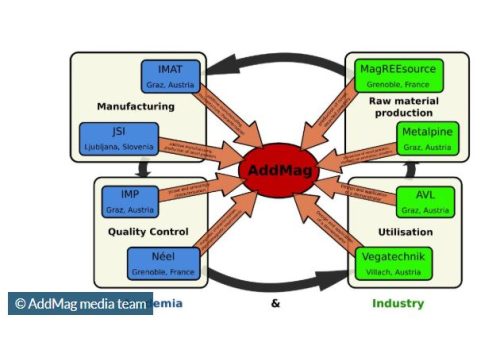
The AddMag project was selected as one of the M-ERA.Net success stories, highlighting its scientific excellence and strong industrial impact in the field of advanced magnetic materials. Funded under the M-ERA.Net programme, the project demonstrated that additive manufacturing can be used to produce permanent magnets with outstanding magnetic performance, high dimensional accuracy, and improved sustainability compared to conventional manufacturing routes.
The project involved the K7 research group of the Jožef Stefan Institute, led by Dr. Benjamin Podmiljšak, which contributed significantly to the development and validation of innovative approaches for the additive manufacturing of magnetic materials and to the demonstration of industrially relevant use cases.
Being recognized as an M-ERA.Net success story, AddMag underlines the importance of international collaboration in advancing circular-economy-based solutions, reducing dependence on primary rare earth resources, and strengthening Europe’s strategic position in sustainable magnet technologies.
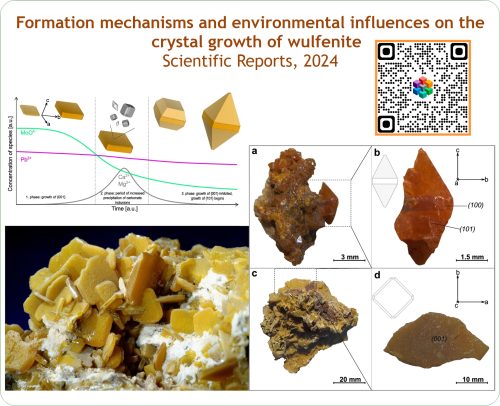
Nik Gračanin je prejemnik fakultetne Prešernove nagrade za leto 2025 za magistrsko delo z naslovom »Mineraloška, kristalografska in geokemična analiza wulfenitnih zrn iz rudnika Mežica«.
Magistrsko delo je nastalo pod mentorstvom izr. prof. dr. Nastje Rogan Šmuc z Naravoslovnotehniške fakultete Univerze v Ljubljani ter somentorstvom prof. dr. Saša Šturma, vodje odseka K7 na Institutu Jožef Stefan.
Delo obsega poglobljeno kristalografsko analizo wulfenitnih zrn iz rudnika Mežica. Skupaj s sodelavci z odseka K7 je vzorce analiziral z različnimi naprednimi metodami, vključno z optično mikroskopijo, odsevno in presevno elektronsko mikroskopijo (SEM, TEM), spektroskopskimi tehnikami (SEM-EDXS in HR-ICP-MS) ter monokristalno rentgensko difrakcijo (SCXRD). Rezultati analiz so predstavljali osnovo za postavitev modela rasti wulfenitnih zrn v Mežici, podrobneje pa bili predstavljeni tudi v znanstvenem članku »Formation mechanisms and environmental influences on the crystal growth of wulfenite«, objavljenem v reviji Scientific Reports.
The Department for Nanostructured Materials, K7, at the Jožef Stefan Institute (JSI) has successfully secured funding under the RSF IND Programme (Pillar IV – Innovation) for the project iRAPTOR: Omni-Directional Magnetic Field-Controlled 3D Printing Device. The one-year project, led by Dr. Muhammad Shahid Arshad, is supported with funding of €50,000 and focuses on advancing functional additive manufacturing of magnetic materials.
The iRAPTOR project aims to develop a novel fused-deposition modeling (FDM) print head equipped with a compact, water-cooled, omnidirectional electromagnet system and integrated Hall-probe sensing. This enables precise, real-time control and verification of magnetic field orientation during printing, allowing voxel-level alignment of anisotropic hard-magnetic particles. The result is polymer-bonded magnets with significantly enhanced remanence and tailored multipolar magnetization patterns.
The technology will be validated on motor-relevant components, including BLDC motor parts, in collaboration with industrial partner Kolektor Mobility and research partner CIM-UPC (Spain). Beyond technical validation, the project also supports intellectual property protection and commercialization activities, strengthening our department’s role in innovation, sustainable manufacturing, and advanced magnetic materials.
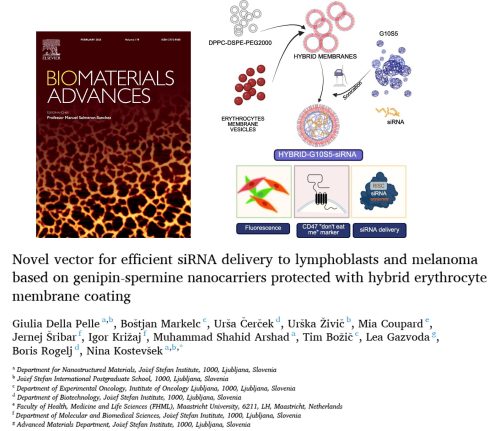
Our latest article from the Nanomedicine group has been published in Biomaterials Advances!
Five research groups joined forces to develop a novel hybrid drug delivery system for nucleic acid therapeutics. By combining genipin-spermine-glycine nanoparticles with biomimetic erythrocyte membrane vesicles, we achieved an efficient and biocompatible carrier for siRNA delivery. Our system demonstrated:
Read the full paper here: https://doi.org/10.1016/j.bioadv.2025.214537
 na 25. regijskem srečanju mladih raziskovalcev osnovnošolcev in srednješolcev Zgornjega Podravja in bronasto priznanje
 na 59. srečanju mladih raziskovalcev Slovenije.