One of the alternative approaches to reducing the consumption of critical rare earth materials in permanent magnets is to optimize their geometry for specific applications, for example in magnetic generators or so-called magnetic harvesters. This generator converts mechanical work into electrical energy and enables the powering i.e., of a smartphone without using an external power source. The proposed concept uses magnets of smaller volumes and more complex shapes. We designed two new permanent magnets for a novel magnetic harvester using the finite element method. The optimization of the dimensional parameters showed that the proposed solutions are more efficient than the existing standard implementations. A schematic representation of the conversion of mechanical energy during human movement to power smart devices and the constructed magnetic harvester are shown in Figure 1. The research results were published in the magazine Materials and Technology in the paper “Optimum design of a permanent-magnet-based self-charging device for a smartphone (https://doi.org/10.17222/mit.2023.968).
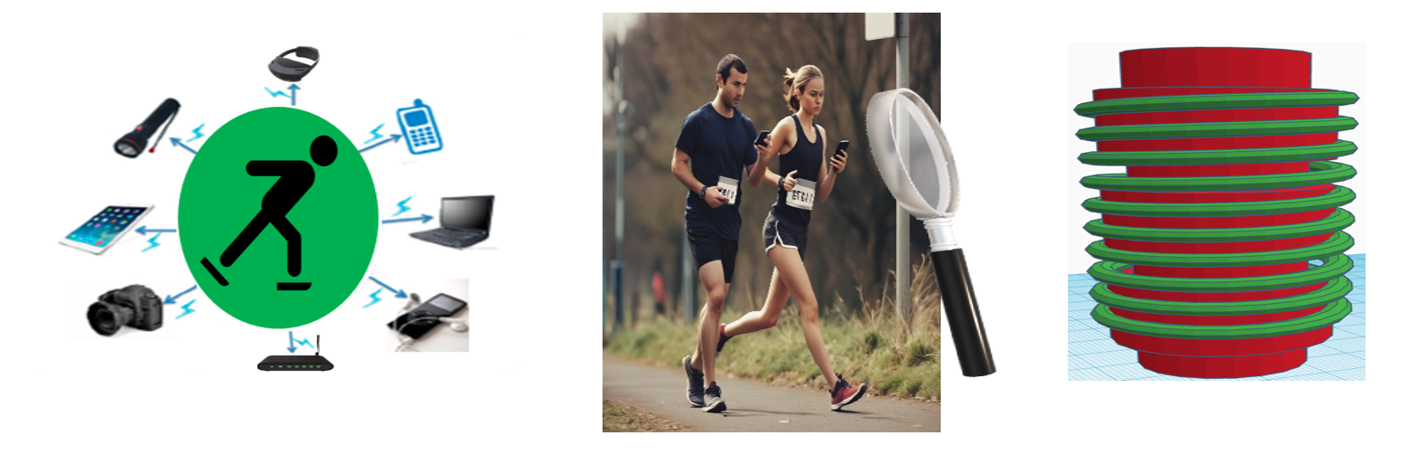
Figure 1: Schematic representation of the conversion of mechanical energy during human movement (left, middle) for powering smart devices and the constructed magnetic harvester (right)