

Contact person: Kristina Žužek, e-mail: tina.zuzek@ijs.si
Contact person: Kristina Žužek, e-mail: tina.zuzek@ijs.si
Europe is at the forefront of the Green Transition,
but its success depends on sustainable energy and mobility solutions.
Magnetic materials group is thus addressing the most pressing European social challenges, which are closely related to the goals of the “European Green Deal” and the “Critical Raw Materials Act”. Namely, we want to contribute to climate neutrality by developing resource-efficient and environmentally friendly e-mobility and green energy production. At the same time, we promote a better circular economy in the use of materials by recycling them, which reduces the EU’s dependence on critical raw materials from foreign sources. Permanent magnets based on critical rare earth elements (Nd-Fe-B, Sm-Co) hold the highest performance and highest energy product. They are of particular concern to the EU as they are indispensable in electric mobility and green electricity production in wind turbines. For this purpose, we devise solutions regarding the design, production and applications of permanent magnets with improved magnetic properties and the efficient use of material resources. Through our work aims gathered below, we strive to develop knowledge and create new solutions to contribute to a more sustainable and resilient future for Europe and beyond.
Modeling activities include theoretical investigations of magnetic materials at three levels:
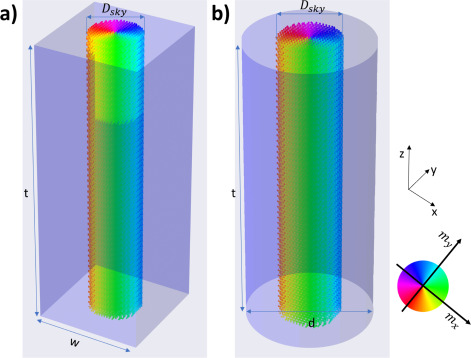
Figure 1: Nanorod (a) and nanowire (b) with stabilized skyrmion string along the length of
the object. The legend for the in-plane magnetization directions is presented in top-down
view where mx and my are magnetization components in the x and y directions, respectively.
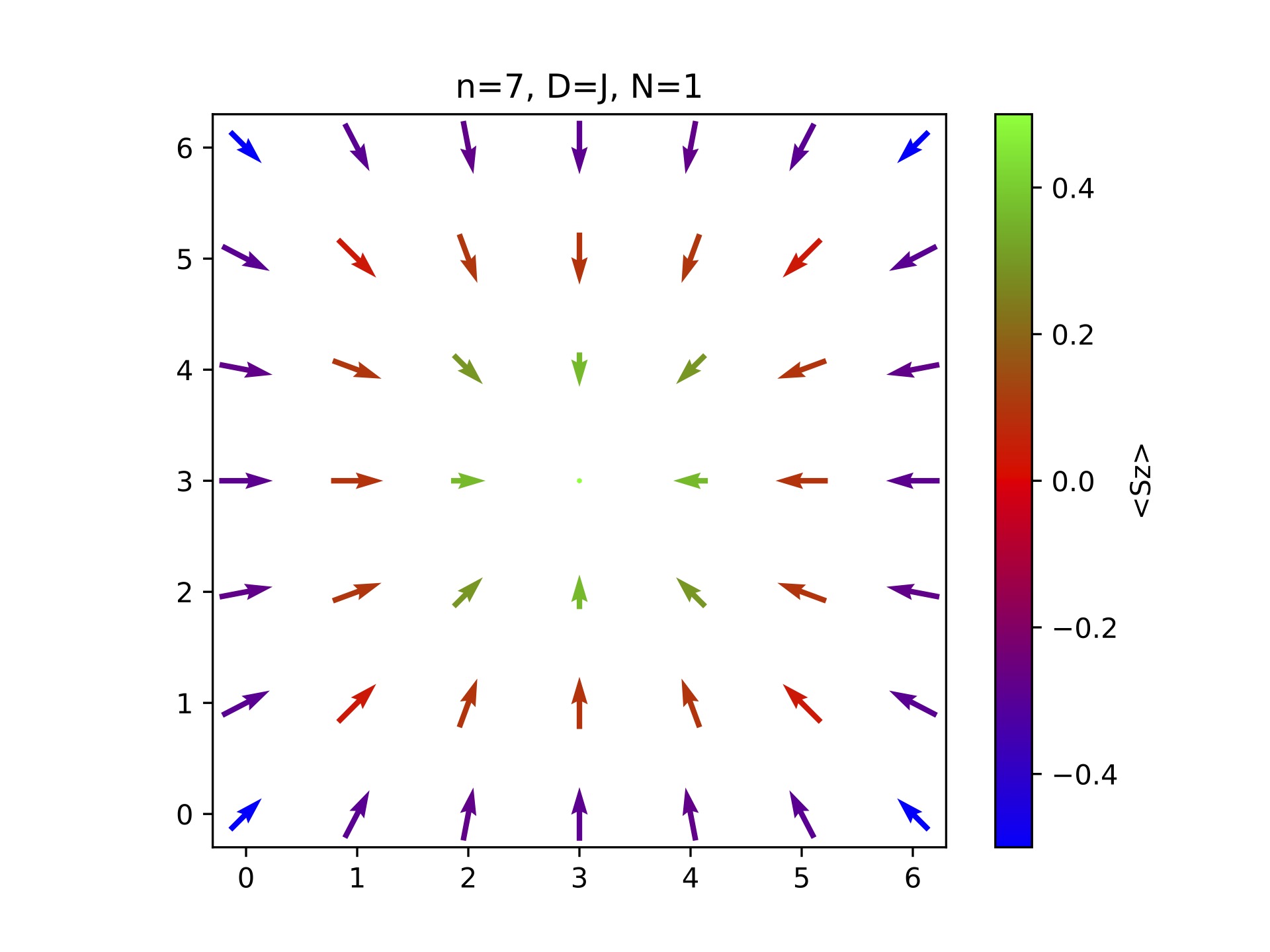
Figure 2: A magnetic skyrmion on a 7 × 7 lattice modeled by applying the VQE quantum
algorithm.
One of the alternative approaches to reducing the consumption of critical rare earth materials in permanent magnets is to optimize their geometry for specific applications, for example in magnetic generators or so-called magnetic harvesters. This generator converts mechanical work into electrical energy and enables the powering i.e., of a smartphone without using an external power source. The proposed concept uses magnets of smaller volumes and more complex shapes. We designed two new permanent magnets for a novel magnetic harvester using the finite element method. The optimization of the dimensional parameters showed that the proposed solutions are more efficient than the existing standard implementations. A schematic representation of the conversion of mechanical energy during human movement to power smart devices and the constructed magnetic harvester are shown in Figure 1. The research results were published in the magazine Materials and Technology in the paper “Optimum design of a permanent-magnet-based self-charging device for a smartphone (https://doi.org/10.17222/mit.2023.968).
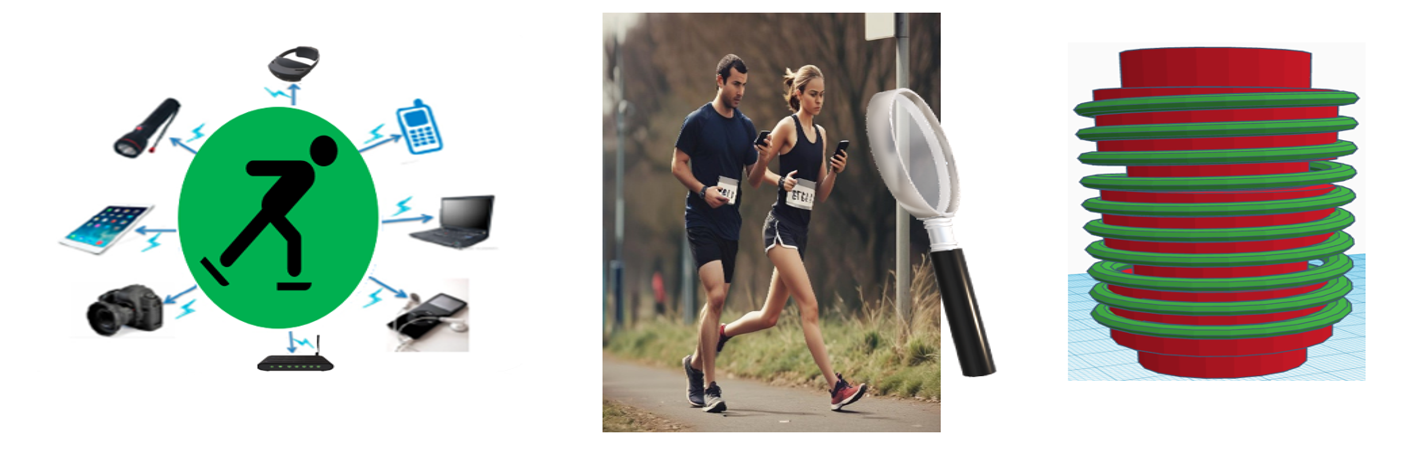
Figure 1: Schematic representation of the conversion of mechanical energy during human movement (left, middle) for powering smart devices and the constructed magnetic harvester (right)
In high-performance Nd-Fe-B-type magnets used in energy-conversion applications, such as electric motors and generators, magnetization reversal is governed by nanoscale demagnetization processes at grain boundaries. The limited freedom to tailor the microstructure of magnets, particularly grain size, grain-boundary structure, and grain-boundary chemistry, has been identified as a key bottleneck of conventional sintering routes.
Our research focuses on development of alternative sintering strategies aimed at reducing the sintering temperature and/or sintering time. By exploring combined pressure/heating regimes and the lower sintering temperatures enabled by contemporary spark-plasma sintering (SPS), we demonstrated a reduced grain growth factor, from ~2 to 1.4, for industrially used Nd-Fe-B powders, thereby overcoming the limitations in attainable grain size associated with conventional high-temperature sintering (https://doi.org/10.1109/TMAG.2024.3417611). Consequently, the high-temperature performance of the material is improved, paving the way toward advanced permanent magnets containing reduced amount of critical heavy-rare-earth elements.
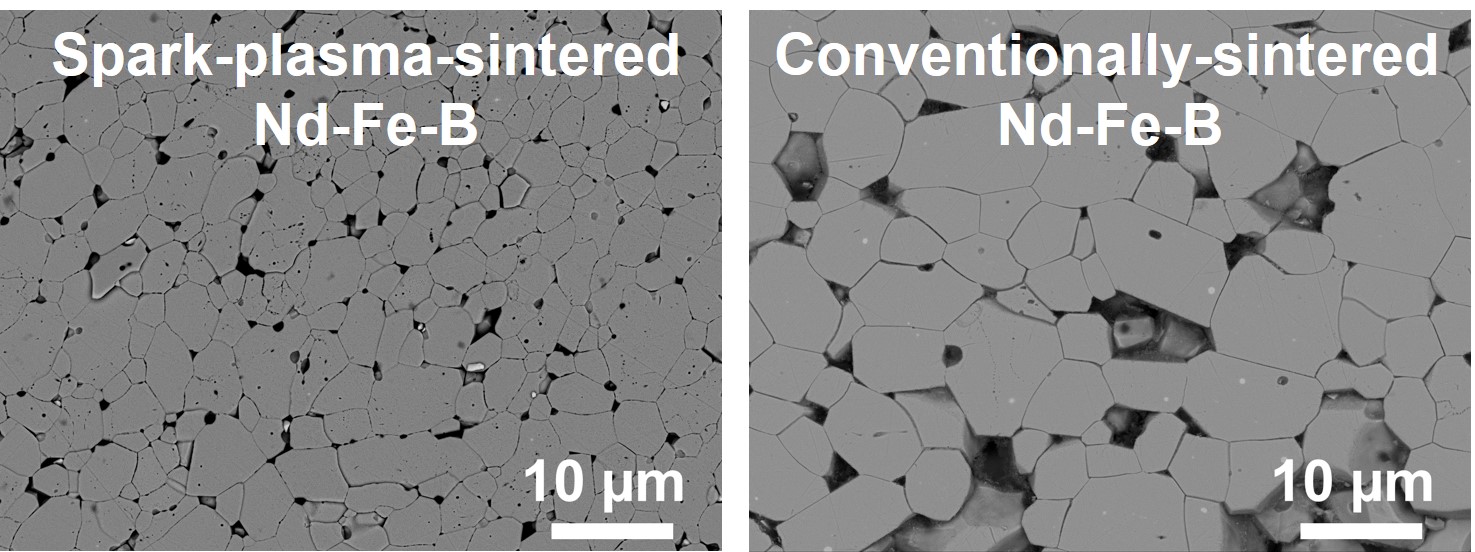
Figure 1: Reduced grain size demonstrated for an industrially-used Nd-Fe-B powder consolidated to full density at low sintering temperature.
In parallel, we are developing rapid pressureless sintering routes based on heating by intense thermal radiation. The new approach to manufacturing bulk, complex, multiphase metallic systems enables controlled heating of powder compacts and full densification within short heating cycles (https://doi.org/10.1002/adem.202401404). Compared to hours-long conventional sintering, the heating time is reduced to less than 10 minutes, including ramping and a short isothermal step. Such heating cycles exhibit energy efficiency at least tenfold greater than conventional approaches. Moreover, the demonstrated rapid sintering provides an unprecedented opportunity to kinetically decouple densification from diffusional processes that control the properties of grain surfaces and grain-boundary phases, including their chemical composition, which strongly affects the performance of current permanent magnets used in traction motors and generators.
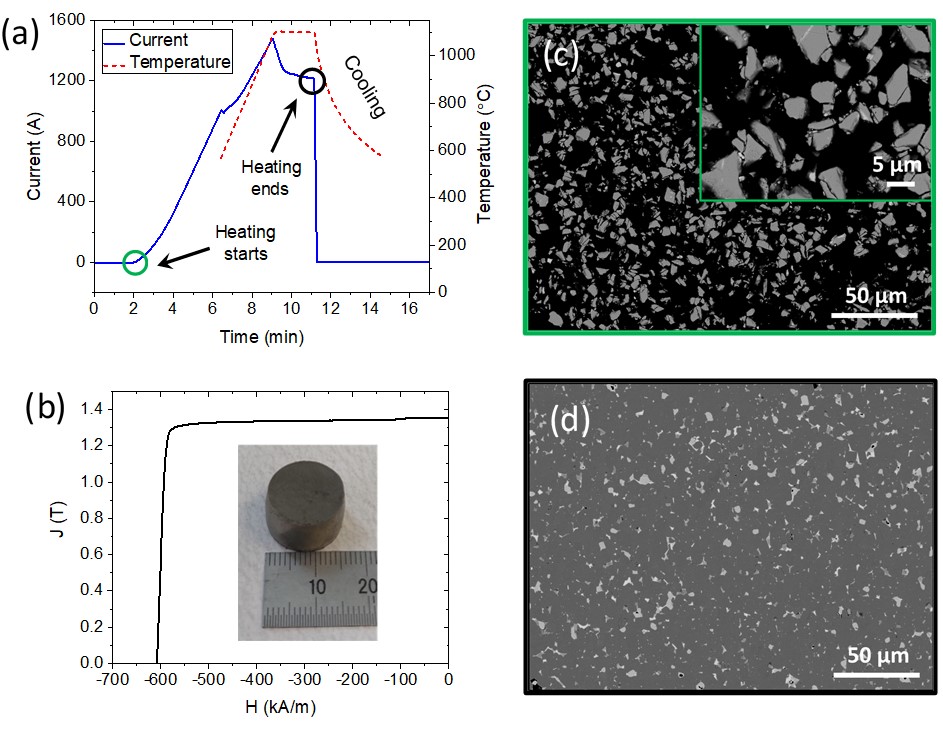
Figure 2: A rapid heating cycle (a) used to synthesise an Nd-Fe-B magnet (b) from a microcrystalline powder (c), achieving full density and favourable microstructure (d) within 10 minutes of heating time.
As part of the MSCA PF OCARINA project (https://cordis.europa.eu/project/id/101024046) we provided guidelines for developing new permanent magnets of the Nd-Fe-B type by tailoring the magnetic properties at the level of individual grains. The strategy involves the preparation of an input material on which a new microstructure of the magnet is built by adding novel phases. The input material must, therefore, be monocrystalline or single-grain and be based solely on the Nd2Fe14B matrix phase. The monocrystalline Nd2Fe14B was obtained by environmentally friendly chemical etching with an organic acid. The latter is selective and preserves the magnetic properties of the Nd2Fe14B matrix phase while successfully removing the Nd-rich intergranular phase, proven on fresh and recycled materials.
The work was published in MDPI Materials in two manuscripts: “Environmentally friendly approach for Nd2Fe14B magnetic phase extraction by selective chemical leaching: a proof-of-concept study (https://doi.org/10.3390/ma16145181) and in “Short-loop recycling of Nd-Fe-B permanent magnets: a sustainable solution for the Nd2Fe14B matrix phase recovery” (https://doi.org/10.3390/ma16196565).

Figure 2: A schematic flow of the selective leaching process of Nd-Fe-B permanent magnets
Our work within the Horizon EU project 101058598 – REEsilience (https://reesilience.eu/) continues the research for the development of new permanent magnets of the Nd-Fe-B type by tailoring the magnetic properties at the level of individual grains. The latter was obtained through selective chemical leaching based on recycled feedstocks. Adding a low-eutectic Nd-Cu alloy in the range between 0-30 wt. % to the single crystal matrix phase Nd2Fe14B, we introduced a new metallic phase source at the grain boundary. The bulk Nd-Fe-B magnets prepared with SPS furnace had a high coercivity Hci=826 kA/m and remanent magnetization Br=1 T. The developed method, which uses Nd70Cu30 instead of pure Nd, supports the development of efficient recycled permanent magnets with a reduced content of critical elements and significant performance. Furthermore, by applying an electrochemical approach to the Nd2Fe14B monocrystalline phase, we successfully deposited 1 µm layer of Cu on the powder particles via chemical reduction. By introducing Cu as a non-critical element into the Nd-Fe-B microstructure, we can further tailor the magnetic properties of Nd-Fe-B magnets at the level of individual grains.
Contact person: Petra Jenuš Belec, e-mail: petra.jenus@ijs.si
Permanent magnets are essential components of modern clean-energy and electrified technologies, including wind-turbine generators, electric vehicles, electric motors, sensors and energy-storage systems. Today, the best-performing permanent magnets are largely based on rare-earth elements, but these materials are associated with supply risk, price volatility, limited European availability and environmental concerns linked to extraction and processing. For this reason, non-rare-earth and rare-earth-lean magnetic materials are becoming an important research direction for improving Europe’s technological resilience and supporting a more sustainable circular economy.
At the Department for Nanostructured Materials, research on non-rare-earth-based permanent magnets focuses on the development, processing and characterisation of sustainable magnetic materials that can partially or fully substitute rare-earth-based magnets in selected energy and transport applications. Within this field, our group contributes to the design and optimisation of recycled REE-free and REE-lean permanent magnets, including M-type ferrite-based systems, W-type hexaferrites, and ferrite-based composites. The research combines powder synthesis, microstructural control, additive manufacturing, advanced sintering and consolidation techniques with detailed phase, microstructure and magnetic-property characterisation. In addition to improving magnetic performance, our group addresses recyclability of production waste and end-of-life ferrite magnets, helping to connect materials development with circular-economy requirements. This integrated approach supports the development of greener permanent magnets for future electric motors, generators and other applications where reduced dependence on critical raw materials is strategically important.
The group is coordinating an ERA-MIN 3 project GENIUS (https://genius-era-min.si/), and is participating, and leading the work package in recycling and sustainability in a Horizon Europe project BEETHOVEN (https://projectbeethoven.eu/).
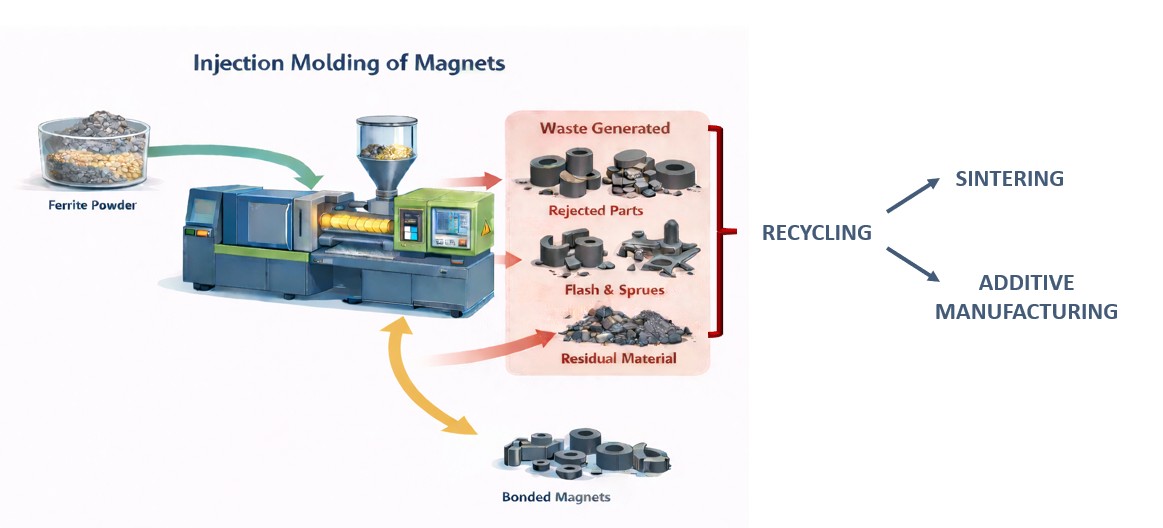
Figure: Scheme of recycling of injection molded waste
A key goal in this segment is the development of clean manufacturing technologies that shorten the path between the initial design stages and finished products. We are dedicated to additive technologies (3D-printing), which enable rapid production of complex magnetic prototypes, both from fresh and recycled powders. In 2023, the EIT Manufacturing aProMag project (www.apromag.eu) was completed. The project aimed to develop innovative rotor prototyping processes for brushless DC motors and actuators using advanced 3D-printing of permanent magnets.
Key innovations included: i) integration of 3D-printing directly in the magnetic field to produce magnetically orientated magnets with improved magnetic properties, ii) use of powder from recycled Nd-Fe-B magnets and iii) cost/time savings through rapid prototyping. The breakthroughs we achieved are a developed sensor system for monitoring magnetic filaments and constructing a precision nozzle to produce magnetically orientated magnets of complex shapes.
Furthermore, in the framework of 3D-printing of permanent magnets we produced filaments based on SrFe12O19 with Polyphenylene Sulfide (PPS) with a filling factor of 70 wt. %. We subsequently printed this filament with a 3D-printer directly onto a permanent magnet. Upon printing in a magnetic field, we increased remanent magnetization by 61% due to improved magnetic orientation. The research entitled “Additive-manufactured anisotropic magnets for harsh environments” was published in the Journal of Magnetism and Magnetic Materials (https://doi.org/10.1016/j.jmmm.2023.171165).

Figure 3: Schematic of printing in a magnetic field (left). Demagnetization curves of the pure Sr-ferrite powder (100%-orange) and the 3D prints (70%-blue), with (solid line) and without (dashed line) an external magnetic field (right) (https://doi.org/10.1016/j.jmmm.2023.171165)
We continued our research on the M.ERA.NET Addmag project (https://www.m-era.net/materipedia/2021/addmag) investigating the additive manufacturing-based production of complex Nd-Fe-B magnets from recycled material. The first attempts to make magnets by 3D-printing and sintering showed that the carbon was not completely removed from the polymer and caused the formation of free iron. We are now optimizing the process to remove all the polymer and testing samples with lower polymer content and different polymers that are easier to remove from the sample.
Nd-Fe-B permanent magnets are a prerequisite for a low-carbon, clean-energy future. However, driven by the rapid growth of the electric-vehicle market, the increasing number of newly installed wind-turbine generators, and the use of advanced magnets in energy-efficient household appliances, global demand for Nd-Fe-B magnets is expected to increase at an annual growth rate of approximately 8% over the next few decades. Owing to Europe’s near-total reliance on rare-earth imports from China, limited European magnet-production capacity, and increasing geopolitical tensions, projections indicate potential global shortages of Nd-Fe-B alloys of up to one-third of the total market within the next decade.
Currently, less than 1% of rare-earth elements such as Nd are recycled, largely because conventional long-loop recycling strategies based on hydrometallurgical and pyrometallurgical processes are often economically challenging and environmentally hazardous. A major research direction pursued by our group is the extraction of the hard-magnetic Nd2Fe14B matrix phase from end-of-life (EoL) magnets and the use of the extracted grains as building blocks for recycled magnets.
We demonstrated the selective leaching of rare-earth-based secondary phases from EoL magnets using a mild organic acid, enabling recovery of the hard-magnetic grains (https://doi.org/10.3390/ma16196565). However, detailed investigation of the extracted grain surfaces by transmission electron microscopy (TEM) revealed an approximately 20 nm-thick oxidized surface layers, attributed to the aqueous leaching medium (https://doi.org/10.1016/j.jallcom.2025.185605). Ongoing studies therefore focus on the development of a selective leaching procedure in a non-oxidizing medium, performed under an inert atmosphere, to produce hard-magnetic powders for further processing and for the synthesis of advanced, material-efficient permanent magnets with novel functionalities.
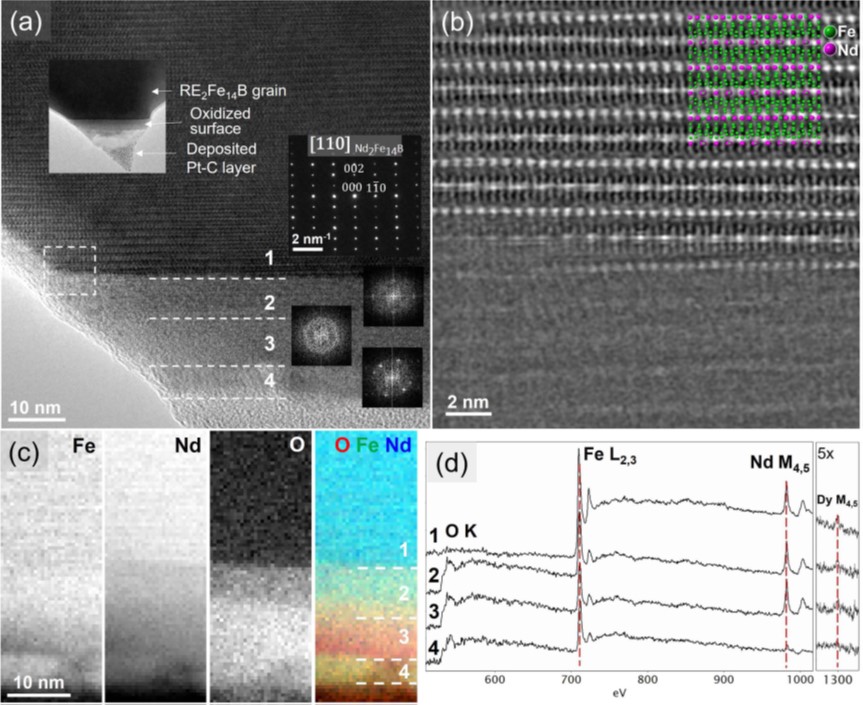
Figure: Surface structure of a Nd2Fe14B grain obtained via selective leaching using a mild organic acid.
Contact person: Sašo Šturm, e-mail: saso.sturm@ijs.si
We investigated Al13Fe4 approximant phase embedded in the fcc Al-rich matrix, where formation of large and highly twinned dendrites was observed. Transmission electron microscopy and electron back-scattered diffraction have been used to identify three types of twins, namely {100}, {001} and {20-1} twins. In this study, we propose the growth mechanism of such 10-fold dendrites, which corresponds to heteroepitaxial growth of the Al13Fe4 approximant from a well-facetted decagonal Al–Fe quasicrystalline seed. Results of this study were published in Intermetallics (https://doi.org/10.1016/j.intermet.2023.108111).
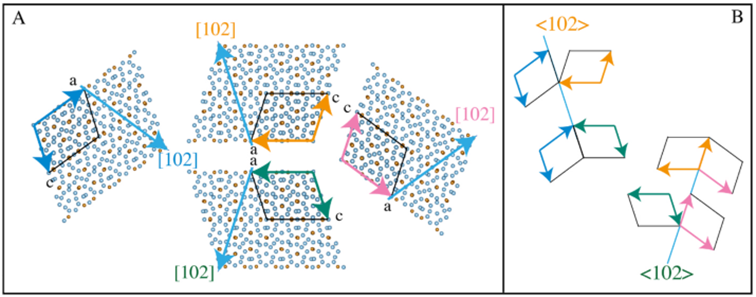
Figure 5: (A) Orientations of the four different grains exposing their Al13Fe4(010) planes. (B) Twinning relationship among the four domains within the same arm. The blue, orange, pink and dark green lattice vectors are gathered by pairs to visualise the twinning relationship identified. (https://doi.org/10.1016/j.intermet.2023.108111)
The link between the surfenergy, friction and a percolation threshold of the dual powder filling, resulting in the optimum mechanical properties of composites. Namely, the incorporation of Al59Cu25Fe13B3 quasicrystalline particles into polymer matrix composite which resulted in increase of tensile and flexural Young’s modulus. Developed composites show high promise in automotive and whiteware appliances, providing mechanical integrity with high strength, low wear and minimal adhesion. The results of this study have been published in Crystals (https://doi.org/10.3390/cryst14030216).