

Contact person: Sašo Šturm, e-mail: saso.sturm@ijs.si
Contact person: Sašo Šturm, e-mail: saso.sturm@ijs.si
We investigated Al13Fe4 approximant phase embedded in the fcc Al-rich matrix, where formation of large and highly twinned dendrites was observed. Transmission electron microscopy and electron back-scattered diffraction have been used to identify three types of twins, namely {100}, {001} and {20-1} twins. In this study, we propose the growth mechanism of such 10-fold dendrites, which corresponds to heteroepitaxial growth of the Al13Fe4 approximant from a well-facetted decagonal Al–Fe quasicrystalline seed. Results of this study were published in Intermetallics (https://doi.org/10.1016/j.intermet.2023.108111).
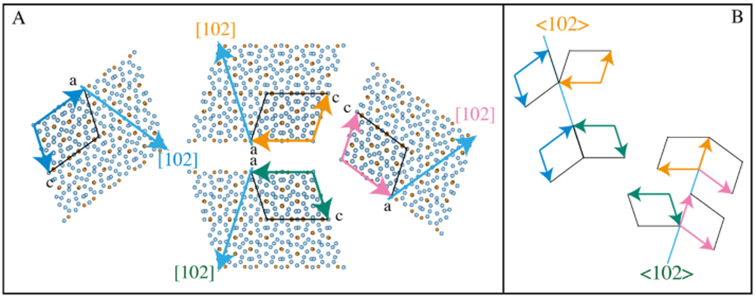
Figure 5: (A) Orientations of the four different grains exposing their Al13Fe4(010) planes. (B) Twinning relationship among the four domains within the same arm. The blue, orange, pink and dark green lattice vectors are gathered by pairs to visualise the twinning relationship identified. (https://doi.org/10.1016/j.intermet.2023.108111)
The link between the surfenergy, friction and a percolation threshold of the dual powder filling, resulting in the optimum mechanical properties of composites. Namely, the incorporation of Al59Cu25Fe13B3 quasicrystalline particles into polymer matrix composite which resulted in increase of tensile and flexural Young’s modulus. Developed composites show high promise in automotive and whiteware appliances, providing mechanical integrity with high strength, low wear and minimal adhesion. The results of this study have been published in Crystals (https://doi.org/10.3390/cryst14030216).