In the field of dental ceramics, we have been traditionally involved in the interdisciplinary translational research of zirconia dental ceramics in collaboration with Department for Prosthetic Dentistry, Medical Faculty, University of Ljubljana (DPD-MF-UL), where numerous in vitro and in vivo clinical studies have been conducted. Rapid sintering and AM are also becoming interesting in the dental ceramic material processing workflow. In 2023, we were invited to contribute to the special issue of the Current Oral Health Reports journal, where we published a review paper entitled “Sintering Strategies for Dental Zirconia Ceramics: Slow Versus Rapid?” (https://doi.org/10.1007/s40496-023-00355-y). The review was made in collaboration with professor Mutlu Özcan, director of Clinic for Masticatory Disorders and Dental Biomaterials, Center for Dental Medicine, University of Zurich, Switzerland.
On the other hand, in collaboration with Montanuniversität Leoben in Lithoz GmbH (Dunaj, Avstrija) (Vienna, Austria), we have studied the effect of airborne particle abrasion and regeneration firing on the subsurface damage and strength distribution of 3D-printed zirconia parts for dental applications. A study published in the leading Dental Materials journal shows how LCM technology is a viable approach for future manufacturing of dental restorations with potential clinical applications (https://doi.org/10.1016/j.dental.2023.10.025). Debonding of zirconia cantilevered resin-bonded fixed dental prostheses remains the main treatment complication. In a short-term randomized clinical trial, nanostructured alumina coating has been shown to be a promising pre-treatment for the bonding surface of zirconia, as published in The Journal of Prosthetic Dentistry (https://doi.org/10.1016/j.prosdent.2021.07.003).
Furthermore, in vitro simulation of prostheses’ long-term exposure to oral conditions further confirmed the coating’s long-term effectiveness. The experimental model was also successfully validated by finite element analysis (FEA), as published in Science Materials (https://doi.org/10.3390/ma16072646).
In an established collaboration with the Department of Prosthetic Dentistry, Center for Dental Medicine, Faculty of Medicine, University of Freiburg, Germany, we have provided expertise on the zirconia ceramics and advanced characterization in a common study, entitled “Long-term stability of hydrothermally aged and/or dynamically loaded one-piece diameter reduced zirconia oral implants”, which showed higher fracture strength than conventionally milled counterparts, that was published in Journal of Functional Biomaterials (https://doi.org/10.3390/jfb14030123).
In collaboration with Charité-Universitätsmedizin Berlin we have performed a fractographic analysis of the 3D-printed and milled composite resins for definitive restorations, published in the Journal of Esthetic and Restorative Dentistry (https://doi.org/10.1111/jerd.13132).
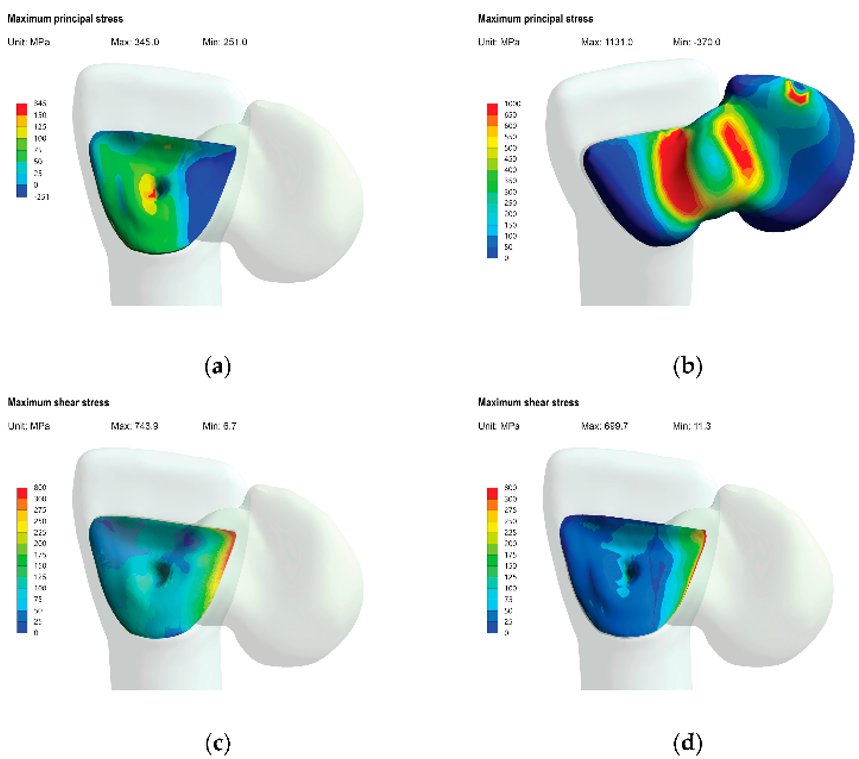
Figure 18: Calculated stresses represented in colorimetric stress maps (MPa) for a resin-bonded fixed dental prosthesis (https://doi.org/10.3390/ma16072646)