

Contact person: Andraž Kocjan, e-mail: andraz.kocjan@ijs.si
Contact person: Andraž Kocjan, e-mail: andraz.kocjan@ijs.si
The main research goal is on developing ceramic materials with novel or improved functions for advanced engineering and biomedical applications through exploring the potentials of innovative processing techniques with a special focus on employing sustainable, patient- and environmentally-friendly concepts. The most recent focus is dedicated to additive manufacturing and advanced sintering concepts to deliver multimaterial and multifunctional engineering ceramics with improved efficiency and reliability. The goal is to obtain a better understanding of the properties of ceramic materials and the mechanisms of their degradation in operation.
We evaluated the effect of infill strategies of thermoplastic 3D-printing (T3DP) on the flaw type population and bending strength of 3 mol.% yttria partially stabilized zirconia (3Y-TZP) bars as published in Open Ceramics (https://doi.org/10.1016/j.oceram.2023.100367), a sisterly open access journal of Journal of the European Ceramics Society. The T3DP rapidly deposits micron-sized droplets, which fuse and solidify to form lines and layers, where we showed that, unlike in fused filament fabrication (FFF), the flaw type population determining strength is less affected by the infill strategies. In relation to FFF, a systematic investigation was carried out for the development of in-house alumina feedstock formulation by extrusion process. The printing parameters and the quality of the printed parts, the debinding and the sintering processes were influenced by the ratio between ethylene vinyl acetate and paraffin wax binder phase in the feedstock. The study was published in Open Ceramics (https://doi.org/10.1016/j.oceram.2023.100496).


Figure 17: Graphic representation of feedstock preparation and FFF additive manufacturing followed by debinding and sintering of 3Y-TZP ceramics (https://doi.org/10.1016/j.oceram.2023.100367), (https://doi.org/10.1016/j.oceram.2023.100496)
In collaboration with Montanuniversität Leoben, Austria (MuL), we have demonstrated the feasibility of texturing lithography-based additively manufactured (LCM) alumina ceramics within minutes by combining rapid radiation heating (~450 °C/min) and short dwell times (<20 min), opening the path for tailoring the microstructure of 3D-printed ceramics using pressure-less rapid sintering protocols. The study was published in Open Ceramics (https://doi.org/10.1016/j.oceram.2023.100428). Textured microstructures in ceramics have gained interest due to their beneficial effect on structural properties, such as increasing damage tolerance. Textured alumina may be otherwise conventionally achieved through templated grain growth (TGG) occurring during sintering at high temperatures and very long dwell times.
In the field of dental ceramics, we have been traditionally involved in the interdisciplinary translational research of zirconia dental ceramics in collaboration with Department for Prosthetic Dentistry, Medical Faculty, University of Ljubljana (DPD-MF-UL), where numerous in vitro and in vivo clinical studies have been conducted. Rapid sintering and AM are also becoming interesting in the dental ceramic material processing workflow. In 2023, we were invited to contribute to the special issue of the Current Oral Health Reports journal, where we published a review paper entitled “Sintering Strategies for Dental Zirconia Ceramics: Slow Versus Rapid?” (https://doi.org/10.1007/s40496-023-00355-y). The review was made in collaboration with professor Mutlu Özcan, director of Clinic for Masticatory Disorders and Dental Biomaterials, Center for Dental Medicine, University of Zurich, Switzerland.
On the other hand, in collaboration with Montanuniversität Leoben in Lithoz GmbH (Dunaj, Avstrija) (Vienna, Austria), we have studied the effect of airborne particle abrasion and regeneration firing on the subsurface damage and strength distribution of 3D-printed zirconia parts for dental applications. A study published in the leading Dental Materials journal shows how LCM technology is a viable approach for future manufacturing of dental restorations with potential clinical applications (https://doi.org/10.1016/j.dental.2023.10.025). Debonding of zirconia cantilevered resin-bonded fixed dental prostheses remains the main treatment complication. In a short-term randomized clinical trial, nanostructured alumina coating has been shown to be a promising pre-treatment for the bonding surface of zirconia, as published in The Journal of Prosthetic Dentistry (https://doi.org/10.1016/j.prosdent.2021.07.003).
Furthermore, in vitro simulation of prostheses’ long-term exposure to oral conditions further confirmed the coating’s long-term effectiveness. The experimental model was also successfully validated by finite element analysis (FEA), as published in Science Materials (https://doi.org/10.3390/ma16072646).
In an established collaboration with the Department of Prosthetic Dentistry, Center for Dental Medicine, Faculty of Medicine, University of Freiburg, Germany, we have provided expertise on the zirconia ceramics and advanced characterization in a common study, entitled “Long-term stability of hydrothermally aged and/or dynamically loaded one-piece diameter reduced zirconia oral implants”, which showed higher fracture strength than conventionally milled counterparts, that was published in Journal of Functional Biomaterials (https://doi.org/10.3390/jfb14030123).
In collaboration with Charité-Universitätsmedizin Berlin we have performed a fractographic analysis of the 3D-printed and milled composite resins for definitive restorations, published in the Journal of Esthetic and Restorative Dentistry (https://doi.org/10.1111/jerd.13132).
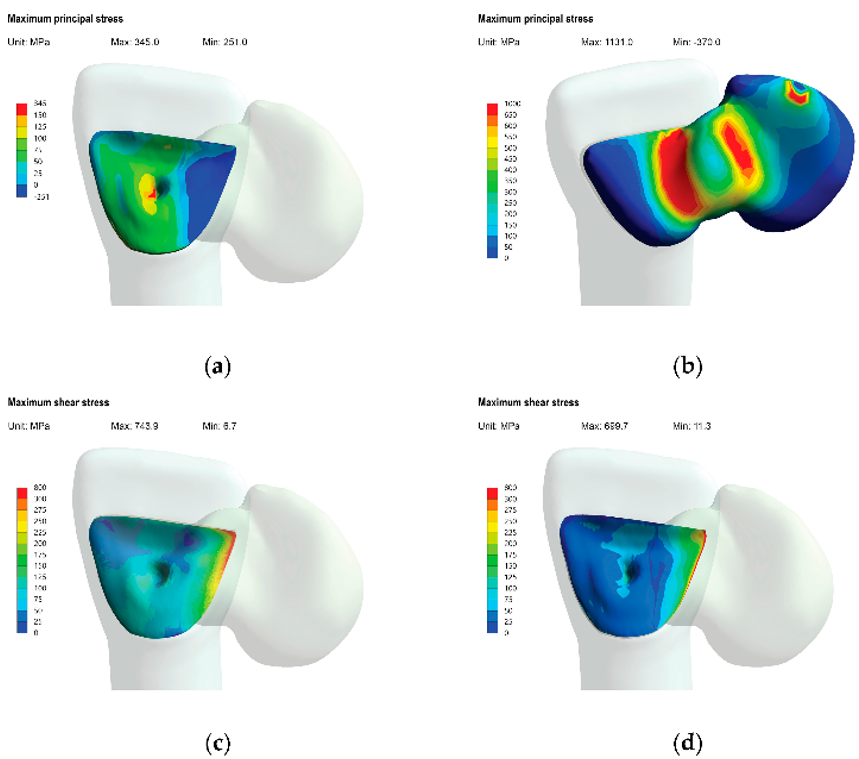
Figure 18: Calculated stresses represented in colorimetric stress maps (MPa) for a resin-bonded fixed dental prosthesis (https://doi.org/10.3390/ma16072646)
Genuine Technologies d.o.o. (GenTech), a start-up company co-founded by several department members is using JSI`s licensed knowledge for the manufacturing of Ca-silicate-based cement (RS+) for endodontic treatment of teeth. In collaboration with Endodent d.o.o., a study was published in the journal Materials (https://doi.org/10.3390/ma16083174), where we compared rheological properties and setting kinetics of bioceramic hydraulic cement RS+ and commercially available benchmark ProRoot MTA. In 2023, GenTech released a new class I medical device, an amorphous bioactive glass formulation for treating hypersensitivity of teeth.