Recent development of liquid-cell TEM holders allows for in-situ studying of materials reactions. Such specialised holders contain liquid cells that can withhold liquid in a confined environment, facilitating the imaging and spectroscopy of samples in reaction media. One of the most studied chemical processes in liquid TEM is related to studies of nucleation, growth, and dissolution processes of nanoparticles and nanostructures. Moreover, combining the capabilities of liquid-cell TEM holders with microsize electrodes printed on a chip, i.e. the in-situ electrochemical liquid transmission electron microscopy (EC-LTEM), enables us to study dynamic phenomena during electrochemical reactions at high spatial and temporal resolution.
This is also the subject of a SLO-FWO joint project where we use the EC-LTEM to investigate the dynamics of the electrochemical deposition and dissolution of metallic nanoparticles (NPs) such as Au, Ag, Pt, and Pd by directly visualising them during the process. In our recent study, we tackled the dissolution process of Au NPs under electrochemical biasing. In-situ EC-LTEM observations showed that upon potentiostatic polarisation, Au NPs dissolve at different stages, revealing a core-shell structure during the dissolution. The shell, which is more resistant, leads to a delayed, particle-by-particle dissolution process once broken down. This phenomenon can be seen in Figure 21, where coloured dotted circles mark various Au NP’s stagewise dissolution. These findings contribute to understanding the complex, stochastic behaviour of gold NP dissolution, which cannot be elucidated only with traditional electrochemistry methods. For more information on the subject, the reader is encouraged to follow the webinar presented by our group member organised within the ESTEEM3 project (https://www.youtube.com/watch?v=m4ZHW7JXoks&t=1472s&ab_channel=ESTEEM3Project).
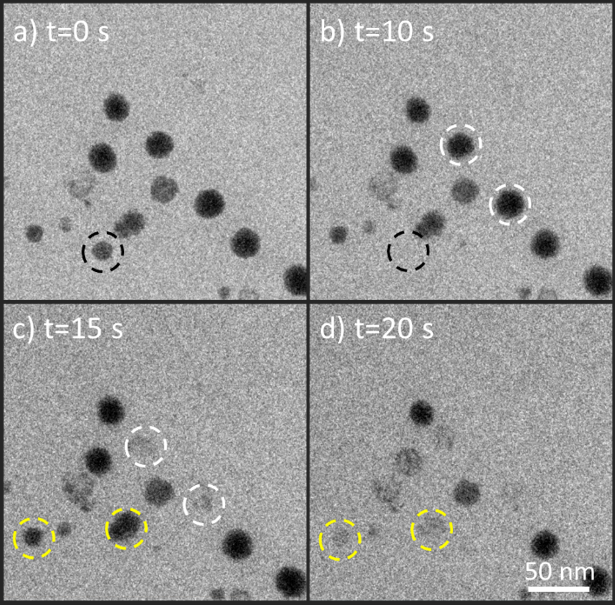
Figure 21: Dissolution of Au NPs under an electrochemical potentiostatic bias observed via in-situ EC-LTEM. Colored dotted circles mark the dissolution of various NPs at various stages.
We are actively involved in the ESTEEM consortium within the ESTEEM3 project (Enabling Science and Technology through European Electron Microscopy – https://www.esteem3.eu/) in the development of various state-of-the-art Transmission Electron Microscopy techniques (TEM) and materials characterisation. The Microscopy research group stays strongly connected with the activities within the Center for Electron Microscopy and Microanalysis (CEMM), mainly through the implementation of various electron microscopy analytical techniques and the possibility for the researchers to access research infrastructure for electron microscopy.