

Contact person: Petra Jenuš Belec, e-mail: petra.jenus@ijs.si
Contact person: Petra Jenuš Belec, e-mail: petra.jenus@ijs.si
Plasma-facing structural materials are one of the bottlenecks to successfully and economically implementing fusion as an energy source. Therefore, the development of novel materials within the framework of the European fusion program EUROfusion (2021-2025) is of the utmost importance for technological progress.
During this period, we continued our research in W-W2C composites to improve the long-term resistance of plasma-facing tungsten-based materials. The W-W2C composite with 4 at. % C in the initial composition exhibits a brittle-ductile transition temperature as much as 200 ° C lower in comparison to current state-of-art tungsten materials foreseen for the divertor application, making it an attractive candidate material.
The continued development is focused on the in-depth investigation of the microstructure-property relationship of this material and the up-scaling capabilities towards the demonstration of industrial-scale manufacturing. Additionally, additive manufacturing of W-W2C is being investigated as a prospective path toward more complex shaped and functionally graded components.
In collaboration with the Department for Low and Medium Energy Physics (F2) we investigated the effect of deuterium retention in tungsten, tungsten carbide, and tungsten-ditungsten carbide composites. The research was published in the Journal of Nuclear Materials (https://doi.org/10.1016/j.jnucmat.2023.154455), indicating that the microstructural and crystal lattice form stable functionally graded plasma-facing components in the W-C system. In 2023, we also published our research on the microstructural development of composite structures between W and WC. A study published in the International Journal of Refractory Metals & Hard Materials (https://doi.org/10.1016/j.ijrmhm.2023.106301) focused on the ability to design stable functional gradient components in the W-C system suitable for use in components in contact with plasma.
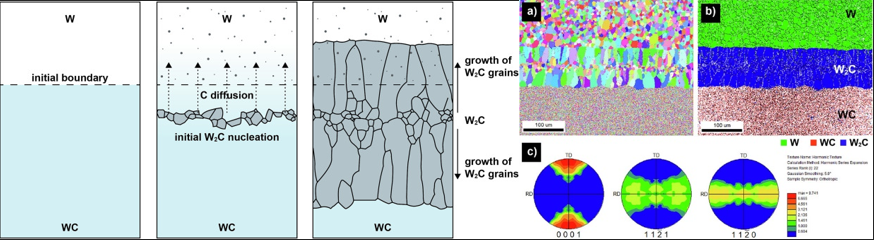
Figure 5: Schematic representation (on the left) and analysis of the formation of the interphase layer between W and WC with use of Scanning Electron Microscopy (SEM) and method Electron Backscatter Diffraction (EBSD) (https://doi.org/10.1016/j.ijrmhm.2023.106301)