

Contact person: Petra Jenuš Belec, e-mail: petra.jenus@ijs.si
Contact person: Petra Jenuš Belec, e-mail: petra.jenus@ijs.si
Fusion energy is one of the most promising long-term routes toward abundant, low-carbon and safe energy production, but its practical implementation depends strongly on the availability of materials that can withstand some of the most extreme conditions in any engineered system. In future fusion reactors, particularly in the DEMO divertor, plasma-facing components will be exposed to high stationary and transient heat loads, hydrogen and helium bombardment, neutron irradiation, thermal cycling and long operational lifetimes. The Fusion Materials Group at the Department for Nanostructured Materials at the Jožef Stefan Institute addresses these challenges through the development, processing and characterisation of advanced tungsten-based materials for future fusion reactors. A central research direction is the engineering of tungsten composites reinforced with in-situ formed W₂C particles, which pin tungsten grain boundaries and improve thermal stability by suppressing excessive grain growth and recrystallisation at high temperatures. This concept, developed by the JSI group, was recognised internationally with the first SOFT Innovation Prize in 2024 (research-and-innovation.ec.europa.eu) for the development of W₂C-reinforced tungsten as a plasma-facing armour material. Building on previous work on isotropic W–W₂C composites, the group is now advancing anisotropic W–W₂C materials by combining powder processing, Field Assisted Sintering Technology and controlled plastic deformation. This approach aims to reduce the brittle-to-ductile transition temperature, improve fracture toughness and strength, and enhance resistance to thermal shock and irradiation damage under DEMO-relevant conditions. The group’s work integrates microstructural engineering, phase and EBSD analysis, thermo-mechanical testing, high-heat-flux validation and deuterium-retention studies, linking fundamental materials science with reactor-oriented performance assessment. Through collaboration with European partners and access to facilities such as PSI-2 and GLADIS, the research contributes directly to the EUROfusion roadmap and to the development of robust, damage-tolerant plasma-facing materials for future fusion power plants.
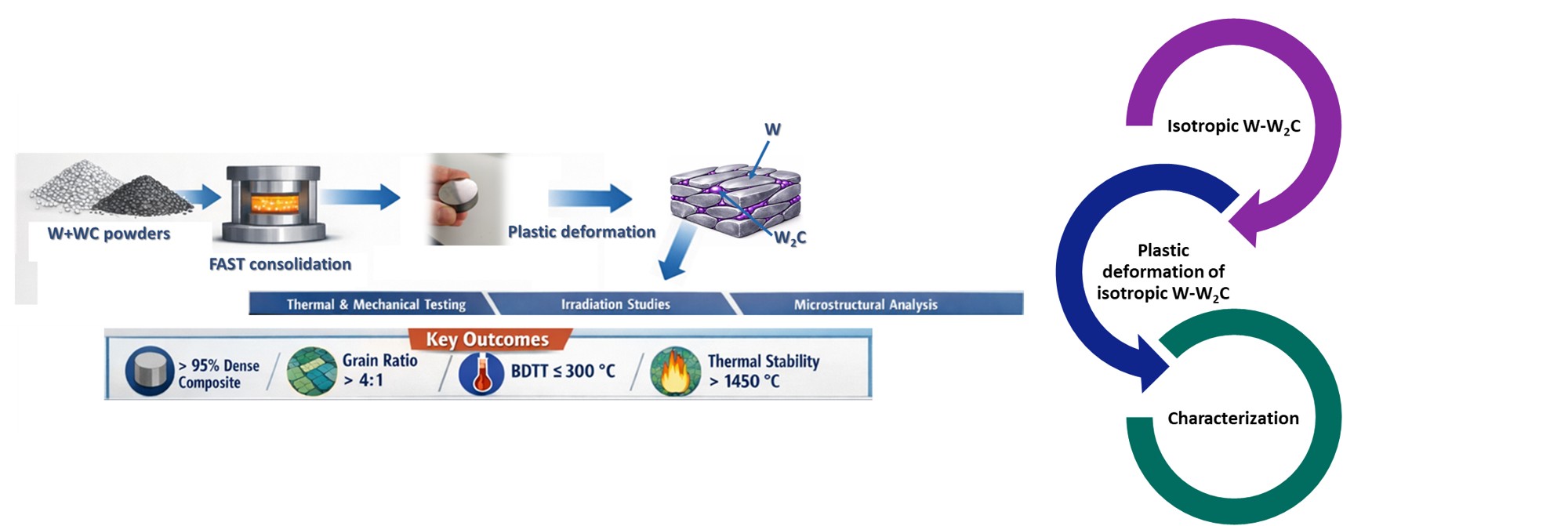
Figure: A scheme of EFFORT project