

Contact person: Belisa Alcantara Marinho, e-mail: belisa.alcantara.marinho@ijs.si
Contact person: Belisa Alcantara Marinho, e-mail: belisa.alcantara.marinho@ijs.si
Catalysis group work is focussed on the development of nanostructured materials with enhanced photo- electro- catalytic properties for applications in energy and environmental fields. Recent efforts have focused onthe synthesis and modification of high entropy materials. The objective is to develop a clearer understanding of the material’s properties and correlate with their catalytic activity, efficiency and selectivity over diverse reactions.
Cantor alloys (CoFeNiMnCr) and its variations (by replacing one or two elements) offer a promising platform for designing electrocatalysts for water-splitting reactions. Namely, by combining multiple elements within a single-phase structure, these materials exhibit unique physicochemical properties that can be tailored across multiple length scales, from the electronic structure to the microstructure. Our work focuses on alloy and oxide systems based on Co, Fe, Ni, Mn, Cr, Cu, and Ti elements, particularly entropy-stabilized alloys for the hydrogen evolution half-reaction and corresponding oxides for the oxygen evolution half-reaction in various electrolytes media. The main aim is to develop earth-abundant electrocatalysts using simple, cost-effective synthesis methods and establish a correlation between their physicochemical properties and electrocatalytic performance.
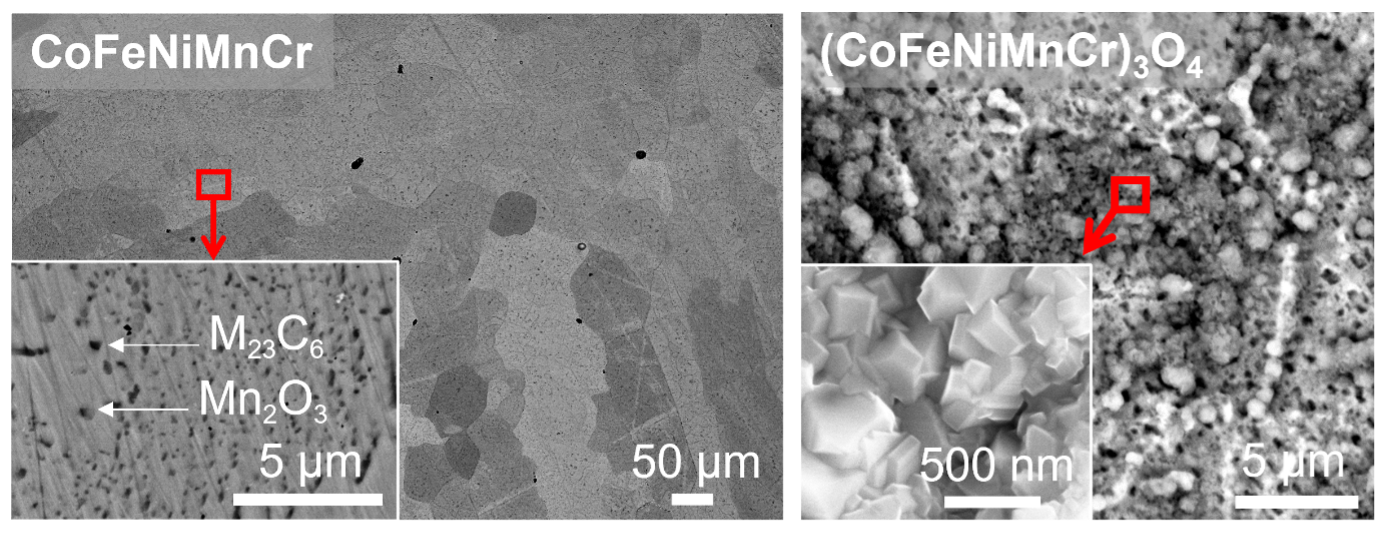
Figure: SEM images of high-entropy alloy CoFeNiMnCr (left) and corresponding high-entropy oxide (CoFeNiMnCr)3O4 (right).
More information on: https://doi.org/10.1007/s10853-024-09710-5 and https://doi.org/10.1016/j.mtcomm.2024.110876
The electrochemical oxidation process, also called anodic oxidation, allows the growth of self-organized 1D nanostructures with high surface area. The anodic oxidation of valve metal substrate should ideally result in a homogeneous distribution of the oxide layer. It is a relatively simple and low-cost synthesis technique that can be easily scaled-up and used for large-scale production of immobilized highly porous electrocatalysts that constitute electrodes without further manipulation. Anodic oxidation of a wide range of materials has been developed by the group resulting in various morphological forms of nanostructured films of titanium oxide, iron oxide, manganese oxide, cobalt oxide and other transition metal elements. These materials can be applied in diverse photo- electro- catalytic processes.
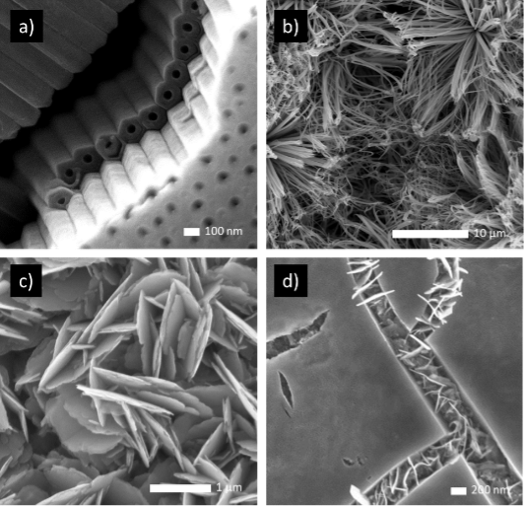
Figure: Scanning electron microscopy images showing different nanostructured films after anodic oxidation: a) TiO2, b) ZnO, c) WO3 and d) FeO.
Selected publications: https://doi.org/10.1016/j.jclepro.2022.131061, https://doi.org/10.1021/acsomega.1c02862 and https://doi.org/10.3390/catal10070803
High-entropy materials (HEMs) have attracted considerable interest in heterogeneous photo(electro)catalysis, offering numerous opportunities to develop new high-entropy-based catalysts with improved catalytic activity. In this context, we use bulk and thin film TaNbHfZrTi high-entropy alloy (HEA) to be converted it into mixed-metal oxide nanotube arrays. These nanotubes are produced by anodic oxidation, a simple electrochemical process in which an electrical voltage is applied to the alloy in a fluoride-containing electrolyte. In this method, the material undergoes a delicate balance between oxide formation and controlled dissolution, leading to the growth of highly ordered, vertically aligned nanotubes with a large surface area. Instead of forming a single oxide, the process yields a combination of metal oxides for each metal within a single structure. The high-entropy effect provides diverse active sites, improved charge transfer, and strong synergistic effects, enhancing the material’s stability, activity, and catalytic efficiency. Moreover, the synthesized nanotubes exhibit excellent photo(electro)catalytic performance for the degradation of antibiotic tetracyclinein (waste)water.
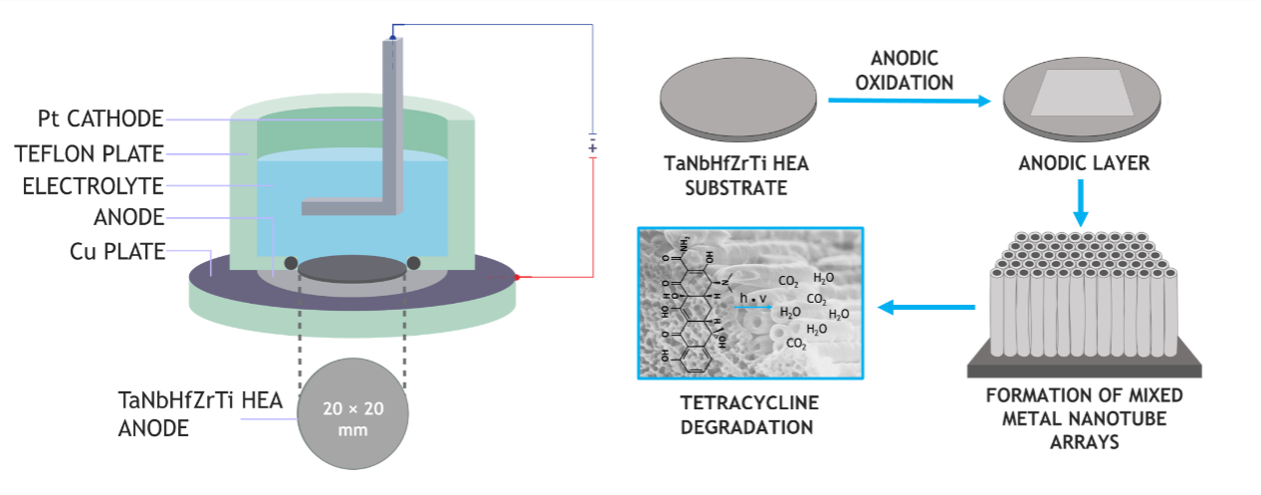
Figure: Schematic illustration of the anodic oxidation process, formation of TiTaNbHfZr nanotube arrays, and their application in the photocatalytic degradation of tetracycline.
Ferroelectric high entropy oxides (FHEOs) are an emerging class of functional materials which exhibit a high entropy effect caused by the multi-principal elemental composition and ferroelectric properties. We fabricated FHEO catalyst based on lead-free (Ba0.2Ca0.2Na0.2Bi0.2Sr0.2)TiO3 composition obtained by engineering the ‘A’-site of the perovskite structure. This FHEO composition exhibited a pseudo-cubic perovskite structure and a relatively dense microstructure with polyhedral grain morphology. The slim nature of the polarisation-electric field (P-E) loop, as well as the broad, frequency-dependent nature of the temperature at dielectric maximum (Tm) of the FHEO composition, suggested a relaxor ferroelectric behaviour caused by the polar nanoregions/nanodomains (PNRs/PNDs). PNRs are nano-sized polar islands that facilitate their short-range internal electric polarisation for the effective separation of photogenerated charge carriers during catalytic processes. The FHEO pellet also exhibited good catalytic activity under UV illumination for the degradation of tetracycline antibiotic.
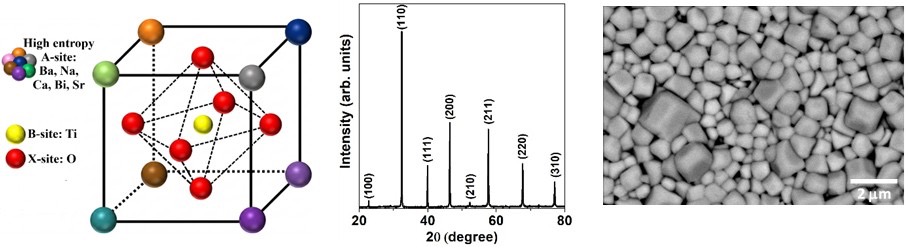
Figure: (a) Schematic representation of the crystal structure; (b) XRD spectrum; and (c) SEM image of the (Ba0.2Ca0.2Na0.2Bi0.2Sr0.2)TiO3 FHEO