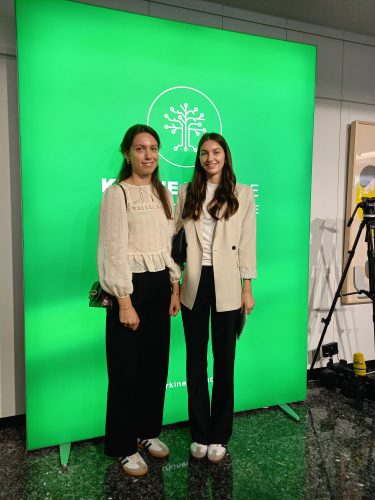
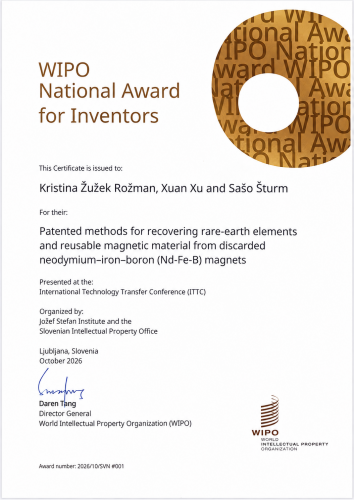
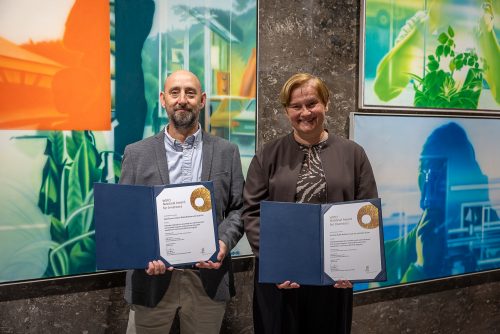
Researchers Xuan Xu, Sašo Šturm and Kristina Žužek (Rožman) from the Jožef Stefan Institute, Department for Nanostructured Materials, received the World Intellectual Property Organization (WIPO) Inventor Award, presented on 9 October in Ljubljana during the 19th International Technology Transfer Conference.
The award recognizes their innovative patented technologies for recycling Nd-Fe-B permanent magnets, enabling the recovery and reuse of critical rare-earth elements. They developed electrochemical methods to recover magnetic grains and selectively extract rare-earth elements from magnet waste.
These technologies contribute to the circular economy, efficient resource use, and sustainable development. Research continues through the GREENE and RecovREE projects, in collaboration with Slovenian and European companies, with a focus on developing resource-efficient, high-performance permanent magnets.
The WIPO award highlights research excellence and the importance of transferring knowledge from JSI to industry.
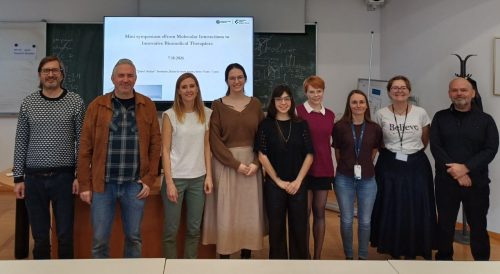
As part of the ARIS J4-70159 project, our department organized a symposium titled “From Molecular Interactions to Innovative Biomedical Therapies” on October 7, 2026, under the leadership of Asst. Prof. Nina Kostevšek. The event featured outstanding speakers from the fields of cell biology, molecular interactions, molecular simulations, and the synthesis of drug delivery systems. Diverse research perspectives sharing a common goal—namely, the development of new therapies—consistently spark interesting discussions and give rise to new ideas.
# ARIS-J4-50150
# Nanostructured materials
# Jožef Stefan Institute
Our latest article from the Nanomedicine group has been published in the Journal of Proteome Research in the scope of ARIS J4-50150 project!
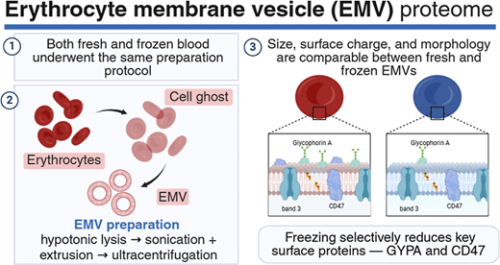
🩸 In this study, we investigated whether erythrocyte membrane vesicles (EMVs) – promising biomimetic nanocarriers for drug delivery – can be produced from frozen blood while preserving their key physicochemical, structural, and protein characteristics.
Using a combination of dynamic light scattering, nano-flow cytometry, cryo-TEM, TEM, and quantitative mass-spectrometry-based proteomics, we compared EMVs prepared from fresh and −80 °C frozen blood.
✨ Key findings:
• EMVs generated from fresh and frozen blood showed broadly comparable size, surface charge, and vesicle morphology.
• Most of the proteome is largely preserved after freezing. Freezing did, however, reduce proteomic complexity and notably affected proteins such as glycophorin A and CD47, which may be important for future applications involving immune interactions and targeted drug delivery.
• Overall, the results indicate that frozen blood can be a viable and practical source for EMV production when immediate processing of fresh blood is not feasible, although further functional studies are needed.
📖 Read the full article:
https://doi.org/10.1021/acs.jproteome.6c00535
#Proteomics #ErythrocyteMembraneVesicles #Nanomedicine #DrugDelivery #BiomimeticNanoparticles #Research #Science #JozefStefanInstitute # ARIS-J4-50150
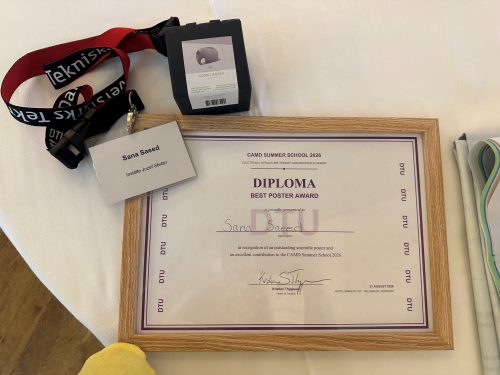
Sana Saeed from the Department for Nanostructured Materials at the Jožef
Stefan Institute received the Best Poster Award at the CAMD Summer
School 2026 – Electronic Structure Theory and Materials Design, held
from 16 to 21 August 2026.
Her poster, “Ab-initio and STM Investigation of the Nd₂Fe₁₄B Surface,”
presented a combined experimental and computational study of the (001)
surface of neodymium–iron–boron (Nd₂Fe₁₄B), an important material for
high-performance permanent magnets. Using scanning tunneling microscopy
(STM), low-energy electron diffraction (LEED), and density functional
theory (DFT) simulations, the research identified an ordered surface
reconstruction with a periodicity of 12.41 Å. The agreement between
experimental and simulated STM images supported a reconstructed Nd-rich
surface model.
The work was carried out in collaboration with researchers from the
Institute Jean Lamour in Nancy, France, and was conducted within the
framework of the GREENE project. The GREENE project focuses on advancing
research in materials and technologies relevant to sustainable energy
applications.
This award recognizes the scientific quality, relevance, and
presentation of the research and strengthens the international
visibility of materials research conducted at the Jožef Stefan
Institute.
More information about the GREENE project is available at https://www.greene-project.eu/
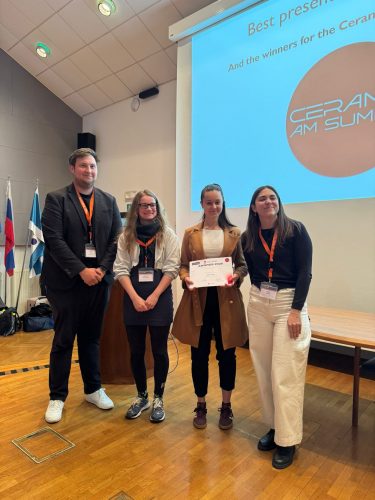
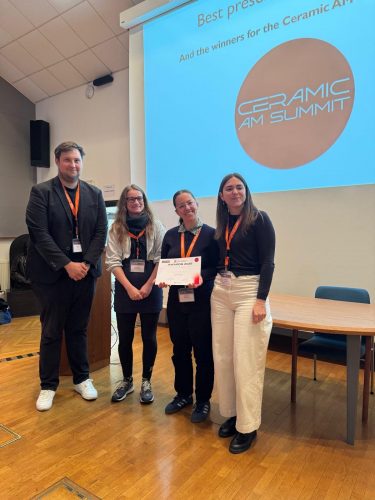
The young Ceramists Additive Manufacturing Forum (yCAM) 2026 took place at Jožef Stefan Institute, from 11th to 13th of May 2026. During yCAM, 3DCERAM Award for Best Speaker was won by Dr. Ipeknaz Özden Moser from Department for Nanostructured Materials (K7), for her talk on “Ceramic additive manufacturing by micron sized droplet jetting of thermoplastic feedstocks”. 3DCERAM Award for Best Poster was won by Pia Popovič, also from Department for Nanostructured Materials (K7), for her poster on “Thermoplastic material jetting of paraffin-wax-based alumina suspensions”. With these awards, they received the chance to present their work at the 2026 Ceramic AM Summit which will be held from 29th of June to 1st of July in Freiburg, Germany, as well as registration and travel grants for this event. Congratulations to both, as well as their supervisors Assoc. Prof. Dr. Andraž Kocjan and Dr. Aljaž Iveković.
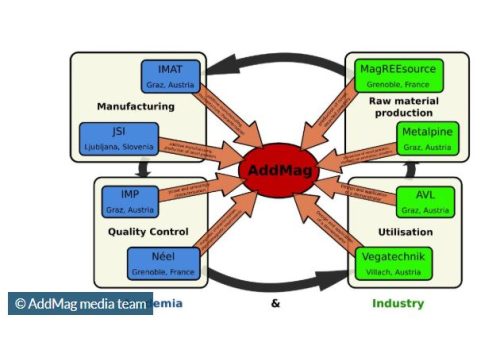
The AddMag project was selected as one of the M-ERA.Net success stories, highlighting its scientific excellence and strong industrial impact in the field of advanced magnetic materials. Funded under the M-ERA.Net programme, the project demonstrated that additive manufacturing can be used to produce permanent magnets with outstanding magnetic performance, high dimensional accuracy, and improved sustainability compared to conventional manufacturing routes.
The project involved the K7 research group of the Jožef Stefan Institute, led by Dr. Benjamin Podmiljšak, which contributed significantly to the development and validation of innovative approaches for the additive manufacturing of magnetic materials and to the demonstration of industrially relevant use cases.
Being recognized as an M-ERA.Net success story, AddMag underlines the importance of international collaboration in advancing circular-economy-based solutions, reducing dependence on primary rare earth resources, and strengthening Europe’s strategic position in sustainable magnet technologies.
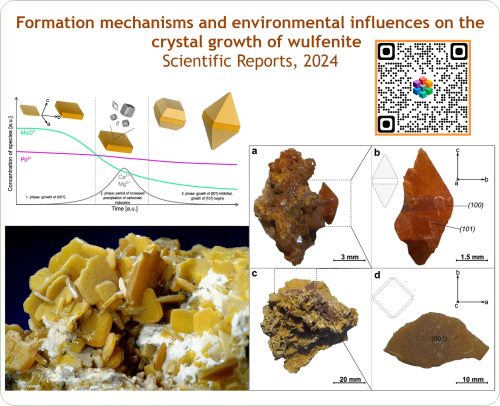
Nik Gračanin je prejemnik fakultetne Prešernove nagrade za leto 2025 za magistrsko delo z naslovom »Mineraloška, kristalografska in geokemična analiza wulfenitnih zrn iz rudnika Mežica«.
Magistrsko delo je nastalo pod mentorstvom izr. prof. dr. Nastje Rogan Šmuc z Naravoslovnotehniške fakultete Univerze v Ljubljani ter somentorstvom prof. dr. Saša Šturma, vodje odseka K7 na Institutu Jožef Stefan.
Delo obsega poglobljeno kristalografsko analizo wulfenitnih zrn iz rudnika Mežica. Skupaj s sodelavci z odseka K7 je vzorce analiziral z različnimi naprednimi metodami, vključno z optično mikroskopijo, odsevno in presevno elektronsko mikroskopijo (SEM, TEM), spektroskopskimi tehnikami (SEM-EDXS in HR-ICP-MS) ter monokristalno rentgensko difrakcijo (SCXRD). Rezultati analiz so predstavljali osnovo za postavitev modela rasti wulfenitnih zrn v Mežici, podrobneje pa bili predstavljeni tudi v znanstvenem članku »Formation mechanisms and environmental influences on the crystal growth of wulfenite«, objavljenem v reviji Scientific Reports.
The Department for Nanostructured Materials, K7, at the Jožef Stefan Institute (JSI) has successfully secured funding under the RSF IND Programme (Pillar IV – Innovation) for the project iRAPTOR: Omni-Directional Magnetic Field-Controlled 3D Printing Device. The one-year project, led by Dr. Muhammad Shahid Arshad, is supported with funding of €50,000 and focuses on advancing functional additive manufacturing of magnetic materials.
The iRAPTOR project aims to develop a novel fused-deposition modeling (FDM) print head equipped with a compact, water-cooled, omnidirectional electromagnet system and integrated Hall-probe sensing. This enables precise, real-time control and verification of magnetic field orientation during printing, allowing voxel-level alignment of anisotropic hard-magnetic particles. The result is polymer-bonded magnets with significantly enhanced remanence and tailored multipolar magnetization patterns.
The technology will be validated on motor-relevant components, including BLDC motor parts, in collaboration with industrial partner Kolektor Mobility and research partner CIM-UPC (Spain). Beyond technical validation, the project also supports intellectual property protection and commercialization activities, strengthening our department’s role in innovation, sustainable manufacturing, and advanced magnetic materials.
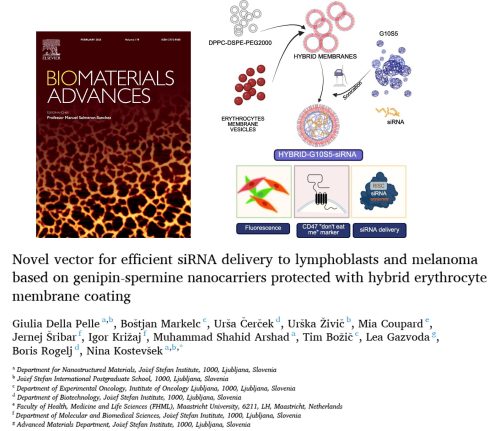
Our latest article from the Nanomedicine group has been published in Biomaterials Advances!
Five research groups joined forces to develop a novel hybrid drug delivery system for nucleic acid therapeutics. By combining genipin-spermine-glycine nanoparticles with biomimetic erythrocyte membrane vesicles, we achieved an efficient and biocompatible carrier for siRNA delivery. Our system demonstrated:
Read the full paper here: https://doi.org/10.1016/j.bioadv.2025.214537
 na 25. regijskem srečanju mladih raziskovalcev osnovnošolcev in srednješolcev Zgornjega Podravja in bronasto priznanje
 na 59. srečanju mladih raziskovalcev Slovenije.