

Contact person: Belisa Alcantara Marinho, e-mail: belisa.alcantara.marinho@ijs.si
Contact person: Belisa Alcantara Marinho, e-mail: belisa.alcantara.marinho@ijs.si
The research vision of the Catalysis group is to apply electrochemical oxidation processing techniques on new classes of materials to tailor/modify the morphology, structure, and chemistry of their surfaces, which, in contact with liquid or gaseous media/substances causes desirable catalytic transformations/degradations of substances via photocatalytic (photoelectrocatalytic, electrocatalytic) processes for various applications in environment and energy.
Apart from the knowledge gained from the previous studies on TiO2, the Catalysis group successfully continued the research on high-entropy materials (HEMs) for catalytic applications. The past knowledge of anodic oxidation process has been implemented on the high-entropy alloys (HEAs) substrate to grow high-entropy oxides (HEOs). The preliminary conversion was tested on refractory TiNbZrHfTa HEA composition.
Our preliminary results showed that anodic oxidation of TiNbZrHfTa resulted in the formation of oxide nanotubes with different diameters by changing the applied potential during HEA anodization (60 V = Ø130 nm, and 30 V = Ø50 nm). This exemplifies how the anodization process itself can tune some morphological features of the nanostructured thin film.
On the other hand, the Cantor HEA alloy showed promising results in the process of oxygen evolution reaction (OER). We successfully synthesized spinel (CoFeNiMnCr)3O4 HEO thin film by electrochemical modification of equiatomic CoFeNiMnCr HEA and subsequent thermal treatment. This synthesis strategy is advantageous since the formed HEO thin film can be considered a well-defined surface, and the thin film thickness can be tuned from nanometers to a few micrometres by processing parameters. The (CoFeNiMnCr)3O4 HEO exhibits a low overpotential for the OER, that is 341 mV at 10 mA/cm2, a Tafel slope of 50 mV/dec, and an unchanged surface after a long-term stability test in alkaline media. These results are similar (or even better) to those obtained by (Co,Cu,Fe,Mn,Ni)3O4 synthesized in powder form and loaded in carbon nanotubes (350 mV, 59.5 mV/dec,) and/or to RuO2 (235 mV, 77.2 mV/dec), thus evidencing the great potential of HEOs for OER.
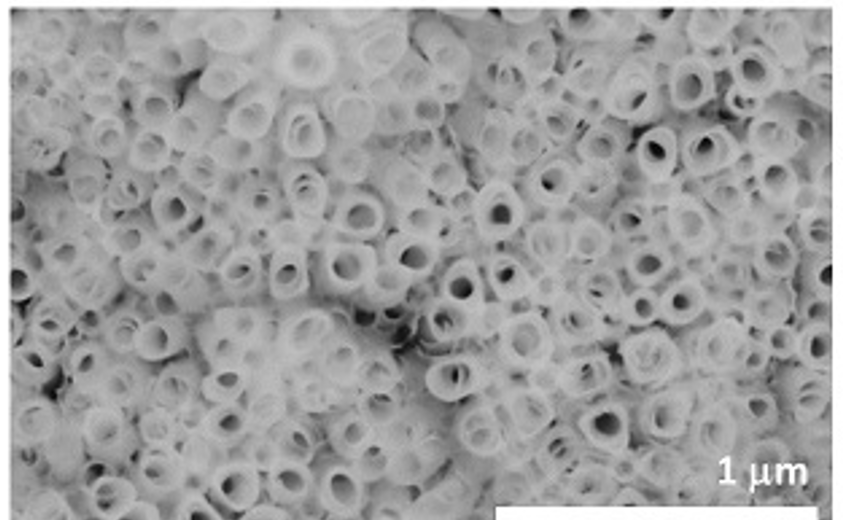
Figure 6: SEM image of anodized TiNbZrHfTa HEA with applied potential of 60 V (upper) and 30 V (lower)
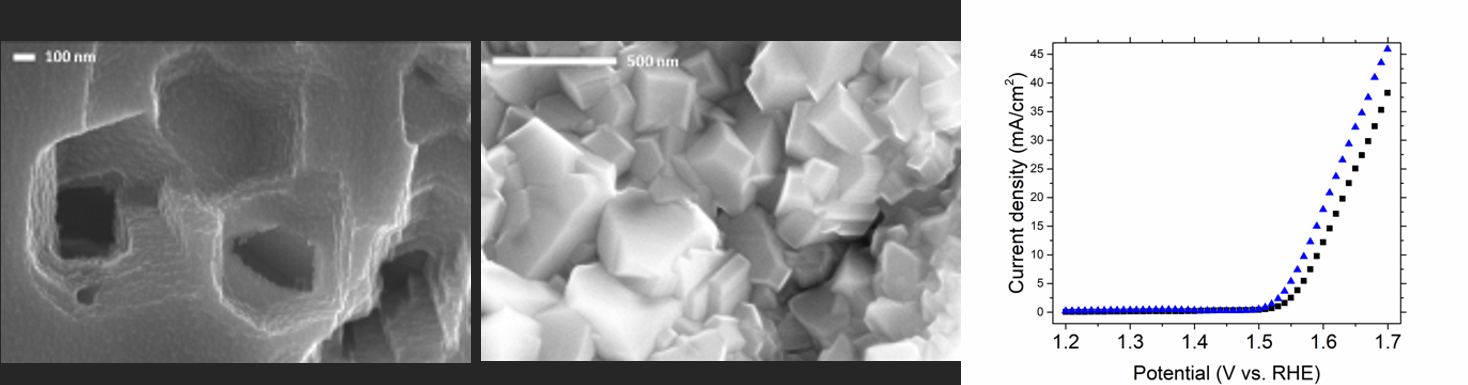
Figure 7: Top-view SEM image of electrochemically treated CoFeNiMnCr HEA (left), (CoFeNiMnCr)3O4 (middle), and LSV curves (right) for (■) CoFeNiMnCr HEA and (▲) (CoFeNiMnCr)3O4.HEO
The interface structure and surface chemistry of rutile fibers were studied in the presence of water by means of advanced high–resolution microscopy and spectroscopy methods combined with the atomistic structure modeling and Density Functional Theory (DFT) calculations. While staying in stable separation throughout their growth, the rutile fibers were shown to adopt a special crystallographic registry that is controlled by strong repulsion forces generated between fully hydroxylated and protonated (110) surfaces. During the relaxation, a turbulent proton transfer and cracking of the O–H bonds was observed, generating a strong acidic character via proton jump from the bridge –OHb to the terminal –OHt groups, and spontaneous dissociation of the interfacial water via a transient protonation of the –OHt groups was observed. Further, it was shown that this particular interface structure can be implemented to induce an acidic response in an initially neutral medium when re-immersed. Our work presents the first demonstration of a quantum confined mineral–water interface capable of memorizing its past and conveying its structurally encoded properties into a new environment.
This discovery has far–reaching implications for water–splitting research. It shows how resolving atomistic structure of mineral–water interfaces is crucial for understanding photocatalytic properties of minerals and can be used as a guide to design mineral–based functional materials.
Our study “Mnemonic rutile-rutile interfaces triggering spontaneous dissociation of water” (https://doi.org/10.1002/adma.202308027), was immediately recognized as of key importance by the Editorial Board of Advanced Materials (IF=29.2) and received high opinions from the reviewers. Following its publication, the paper was tagged as Editor’s Choice and highlighted as Hot Topic in the Section of catalytic water splitting. The key authors of this article come from the Department of Nanostructured Materials.
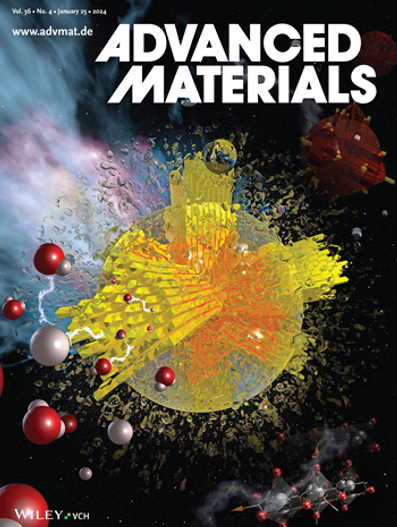
Figure 8: Cover (Adv. Mater. 4/2024)