

Contact person: Matejka Podlogar, e-mail: matejka.podlogar@ijs.si
Contact person: Matejka Podlogar, e-mail: matejka.podlogar@ijs.si
The Microplastics group is dedicated to developing innovative methods for the efficient removal of environmental micro- and nanoplastics, particularly near their sources. Our research focuses on the synthesis of advanced photocatalysts, the mechanisms of photo- and biodegradation, detailed characterization of photocatalytic materials, and the analysis of structural and chemical changes occurring in micro- and nanoplastics during treatment.
All our research areas, photocatalyst synthesis, photodegradation, biodegradation, and material characterization converge in our study of large hailstones that fell in Slovenia. In this work, we discovered diverse microorganisms and fibers of both natural and anthropogenic origin. For the first time, we detected the presence of microplastic fibers in giant hailstones and analyzed changes in the distribution of mineral particles within their volume. The results were published in Science of The Total Environment (https://doi.org/10.1016/j.scitotenv.2022.158786, IF 9.8).
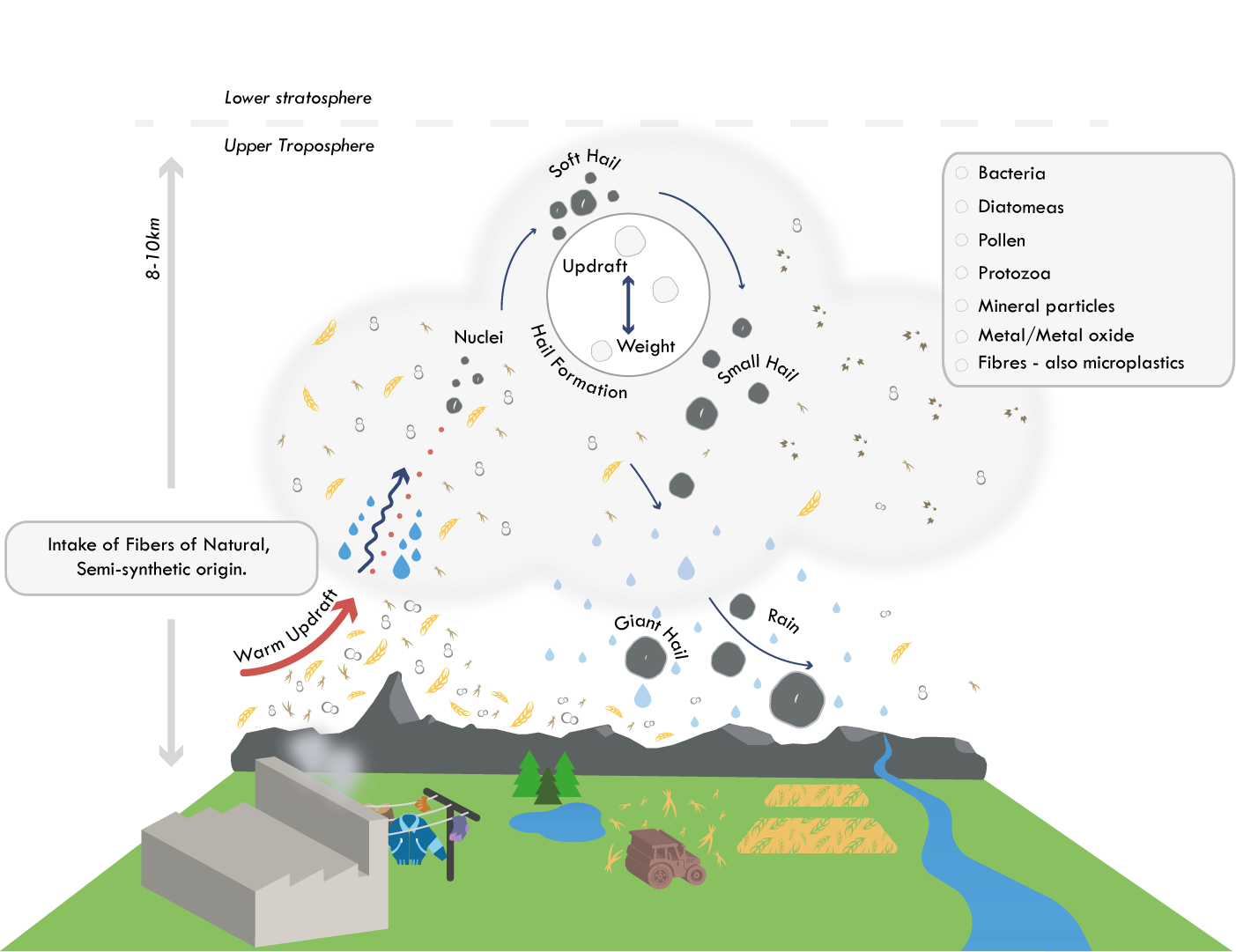
Figure 1: The figure illustrates a possible mechanism for the formation of giant hailstones, initiated by small particles originating from environmental pollution. Strong updrafts likely carry light fibers higher into the atmosphere, and heavier sand particles remain at lower altitudes. Higher up and with lower moisture concentrations than usual, giant hailstones are likely to form, which only grow on their way towards the ground. https://doi.org/10.1016/j.scitotenv.2022.158786
Efficient metal oxide photocatalysts (ZnO, TiO2, etc.) have been developed using hydrothermal and solvothermal synthesis, as well as atomic layer deposition (ALD). ZnO thin films and doped by copper atoms, published in Ceramics International (https://doi.org/10.1016/j.ceramint.2023.08.196, https://doi.org/10.1016/j.ceramint.2025.07.068) demonstrated enhanced photocatalytic properties. Further, ZnO nanorods were investigated for the photocatalytic degradation of caffeine under visible light irradiation, published in Ceramics International https://doi.org/10.1016/j.ceramint.2024.04.410 and nanocomposites based on TiO2 and reduced graphene oxide, as published in MDPI Molecules (https://doi.org/10.3390/molecules28217326), were explored for the removal of methylene blue dye under visible light. This work was carried out within the ARIS project L2-1830 and ARIS bilateral project BI-HR/20-21-003.
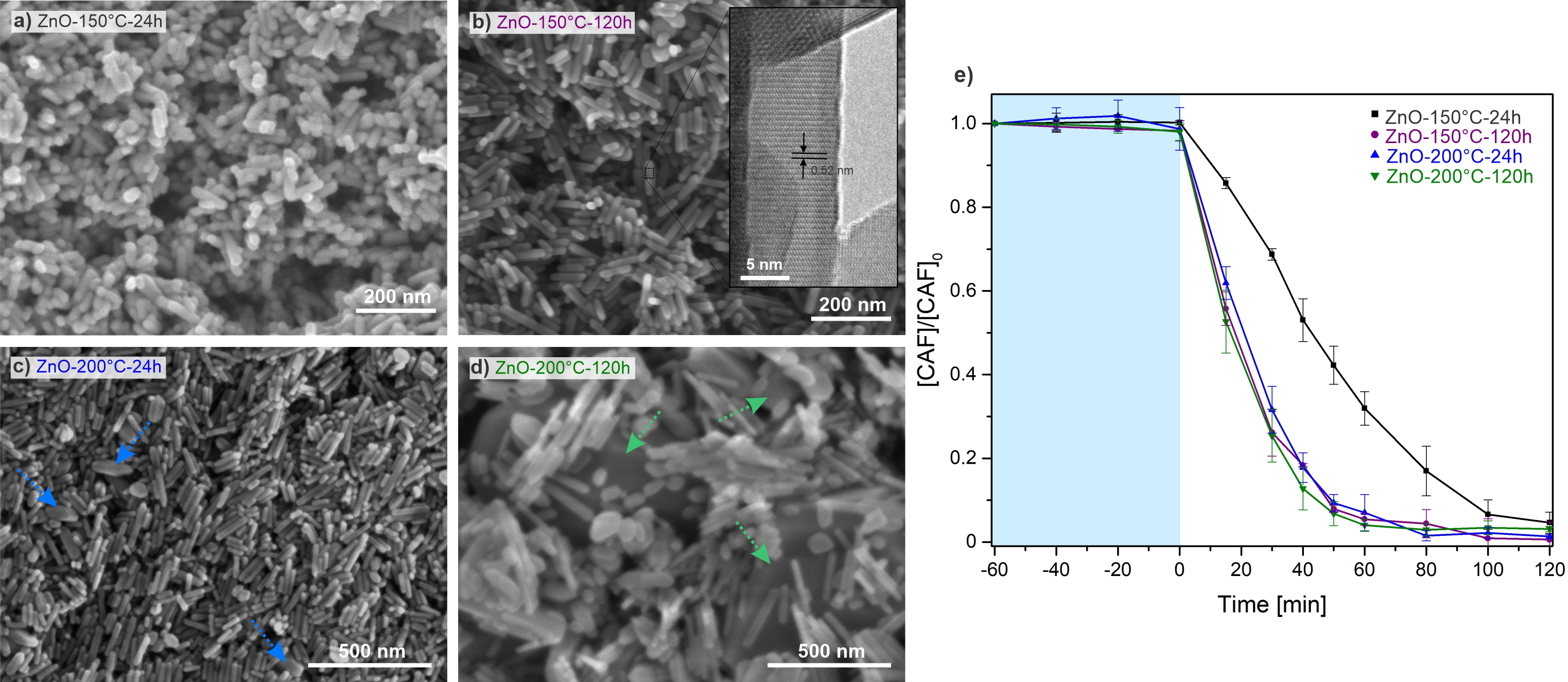
Figure 2: SEM images of ZnO nanorods solvothermally synthesized at different temperatures and reaction times, accompanied by a graph showing the photocatalytic degradation of caffeine in the presence of the four ZnO nanorod powders. https://doi.org/10.1016/j.ceramint.2024.04.410
Within the ARIS project J4-2549 we identified two fungi, Coniochaeta hoffmannii and Pleurostoma richardsiae, capable to colonize the polypropylene (PP) fibers, published in Microbiological Research (https://doi.org/10.1016/j.micres.2023.127507). And we demonstrated that respirometric screening of environmental fungal isolates, combined with SEM, FTIR and Raman spectroscopy, can be used to identify novel fungal strains with potential for plastic polymer degradation, published in Heliyon (https://doi.org/10.1016/j.heliyon.2024.e31130).
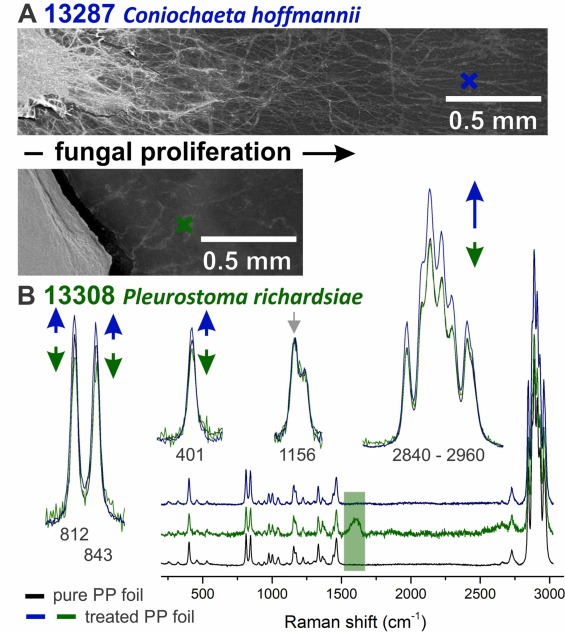
Figure 3: SEM images show that C. hoffmannii (A) spreads across the surface more than P. richardsiae (B). Raman spectroscopy reveals PP bond damage due to overgrowth of each fungus on the surface of pure polypropylene (PP) film. https://doi.org/10.1016/j.micres.2023.127507
From discovering microplastic fibers trapped in hailstones to exploring biological and photocatalytic pathways for their degradation, our research addresses microplastic pollution from its atmospheric transport to its removal from water. By combining insights from biodegradation, photocatalysis, and materials science, we aim to develop sustainable and practical solutions for wastewater treatment, focusing on photocatalytic filters suitable for industrial, municipal, and domestic wastewater applications.