

Contact person: Nina Kostevšek, e-mail: nina.kostevsek@ijs.si
Contact person: Nina Kostevšek, e-mail: nina.kostevsek@ijs.si
The group Nanomedicine is working on the development of biomimetic delivery systems for innovative cancer treatment and diagnostics, focusing on the following areas:
One of the most revolutionary achievements in this new era is gene therapy, which focuses on the use of therapeutic delivery of nucleic acids into the patient’s cells (so-called transfection). Despite the great potential for therapy, the biggest challenges are related to the efficient delivery of nucleic acids to the target site and immunogenicity. Therefore, the development of new, safer and, at the same time, highly effective transfection agents is crucial for progress in this field. In 2023, we carried out a breakthrough study where we developed a new and efficient procedure for the preparation and purification of vesicles from erythrocyte membranes as a delivery system for nucleic acids for the purpose of gene therapy (Figure 12). The entire process is completed in four hours, representing an important step forward in realising personalised medicine therapies, which remains the greatest challenge of the 21st century. We performed a detailed characterisation of these vesicles using advanced electron microscopy methods in collaboration with the Nationa Institute of Chemistry, Ljubljana, and the Institute for Cell Biology, Faculty of Medicine, University of Ljubljana. We have proven that the vesicles effectively protect nucleic acids from enzymatic degradation with high stability for up to one month.
In cell models and then in animal models, we demonstrated the effectiveness of target gene silencing with our vesicles containing encapsulated siRNA.
The study was carried out in collaboration with the Oncology Institute of Ljubljana. The article has been submitted for peer review by Journal of Controlled Release.
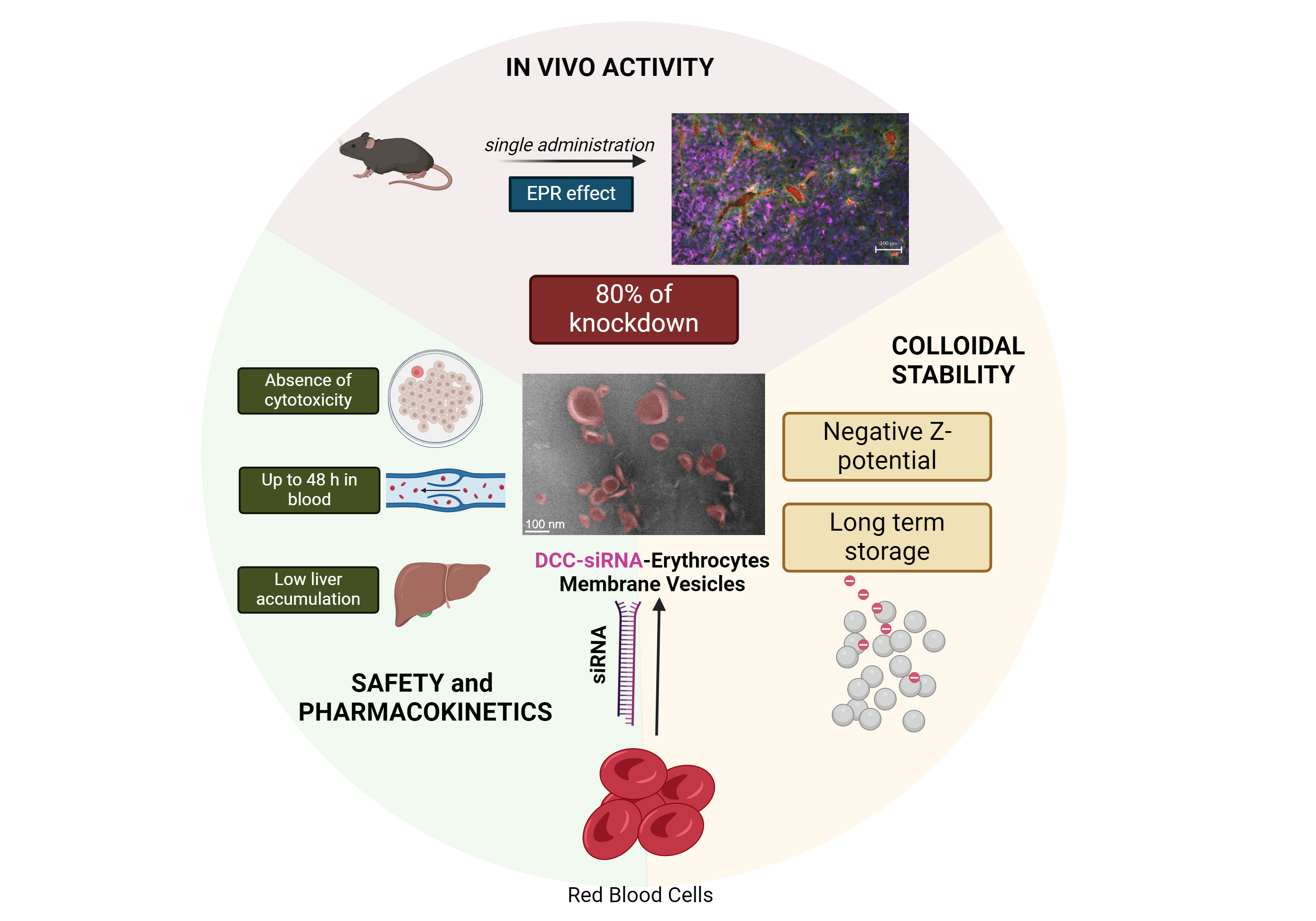
Figure 12: Schematic sum-up of siRNA-loaded erythrocytes membrane vesicles (EMVs). EMVs retained parental erythrocytes zeta potential and they were stable up to 4 weeks at 4°C. We tested their gene silencing ability in vitro on B16F10 murine melanoma cell line and in tumor-challenged mice. We also determined their biodistribution and pharmacokinetic properties and found that the vesicles significantly increase the circulation time (a few minutes for free siRNA to 48 for encapsulated in vesicles).
As an extension of this study, we started with an active method of targeting breast cancer cells in order to improve the selectivity and efficiency of siRNA delivery to these cells. For this purpose, we use molecular modeling methods to determine the optimal sequence of peptides that demonstrate high selectivity and affinity to target receptors. We have successfully bound the selected peptide to the surface of the vesicles and will continue testing on cell models in 2024.
In addition to the use of vesicles from erythrocyte membranes, we also developed innovative, cationic polyamine nanoparticles from natural ingredients (genipin and polyamines) as a safe and efficient delivery system for RNA molecules (Figure 13). The proposed nanoparticles also exhibit fluorescent properties, which can be advantageously used for imaging purposes.
Fluorescent genipin-polyamine nanoparticles as carriers of nucleic acids represent a complete innovation in the field of transfection and delivery of nucleic acids.
In addition, we tested this system on a number of cell models, including those where the uptake of nucleic acids is particularly difficult (lymphoblasts). We have demonstrated that genipin-polyamine nanoparticles are an extremely efficient and much safer transfection agent than commercially available reagents (e.g. Lipofectamine), which indicates a great potential for continuing pre-clinical experiments and also transfer towards higher levels of technological development. The results of this study are currently in peer review in the Journal of Nanobiotechnology (impact factor 10.2).
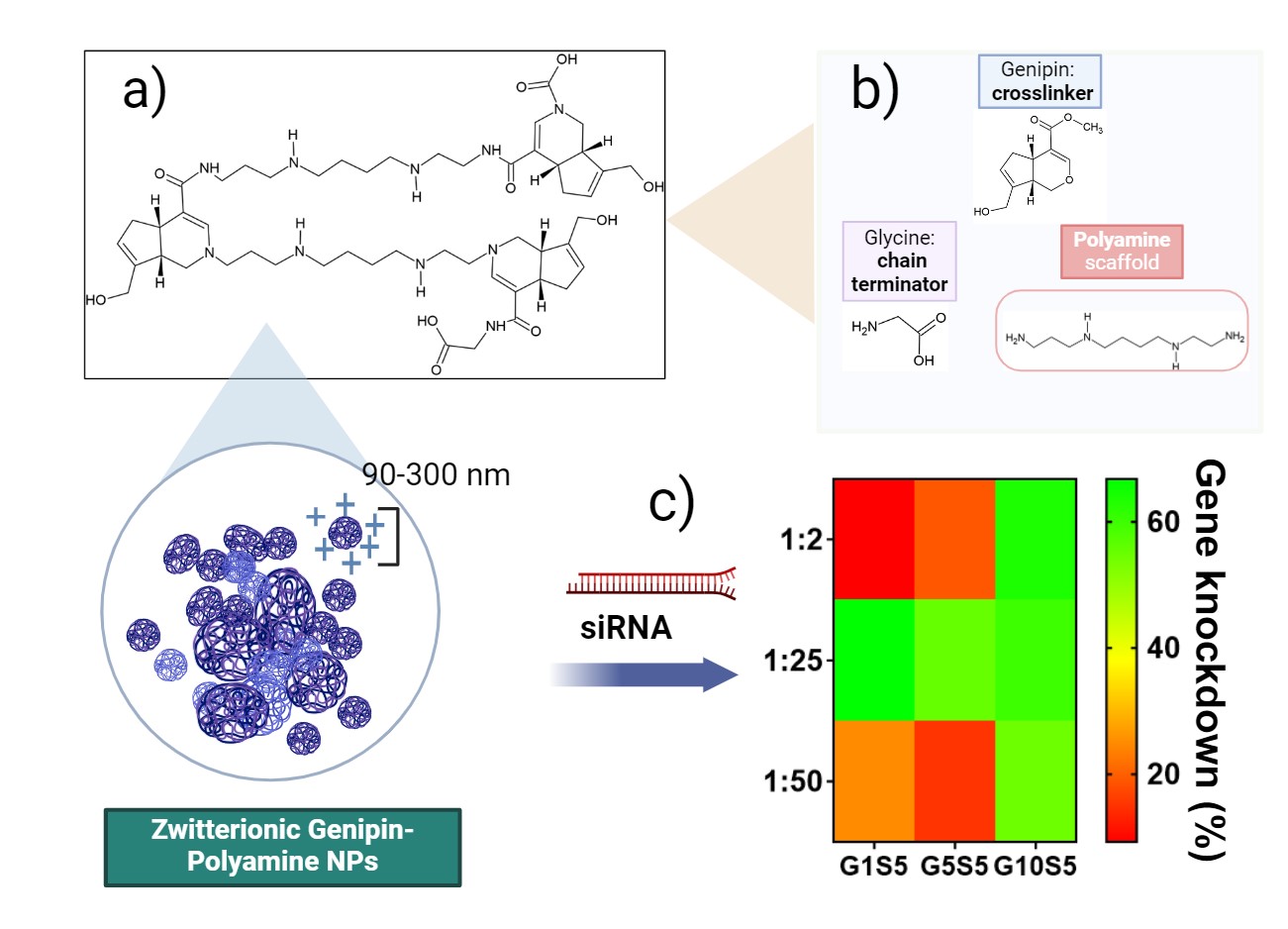
Figure 13: a) General structure of genipin-polyamine polymeric nanoparticles (NPs) with size 90-300 nm. For the sake of simplicity, some chemical bonds were elongated and the picture is not representative of the structural arrangement of the polymer in water or buffer. b) Components of polymers and their function in the synthesis process; c) Gene knockdown efficacy (%) upon incubation of B16F10 cell with siRNA-containing polymeric NPs, as determined via qRT-PCR analysis.
In the field of photo-thermal therapy, we intensively test many nanomaterials, from magnetic nanoparticles, gold nanostructures, carbon dots, bismuth-selenide structures, etc. We have published two articles in this field. The first one, in collaboration with the University of Nova Gorica, entitled “Silica coated Bi2Se3 topological insulator nanoparticles: an alternative route to retain their optical properties and make them biocompatible” in the journal Nanomaterials (https://doi.org/10.3390/nano13050809). Another article was a result of collaboration with the Politecnico di Torino, Italy, entitled “Tannic-acid-mediated synthesis and characterisation of magnetite–gold nanoplatforms for photothermal therapy”, published in Nanomedicine (https://doi.org/10.2217/nnm-2023-0134).
Besides excellent research, our mission is also to present our research findings to the general public. For this purpose, Dr. Nina Kostevšek conducted a radio interview on the »Podobe znanja broadcast«, ARS, entitled “How red blood cells can deliver medicines instead of oxygen” (https://365.rtvslo.si/arhiv/podobe-znanja/174962029). And then a video interview and a podcast for the Slovenian Press Agency entitled “Slovenian researcher with nanotechnology for more effective cancer treatment” (http://znanost.sta.si/3203860/slovenska-raziskovalka-z-nanotehnologijo-do-bolj-ucinkovitega-zdravlenja-raka).