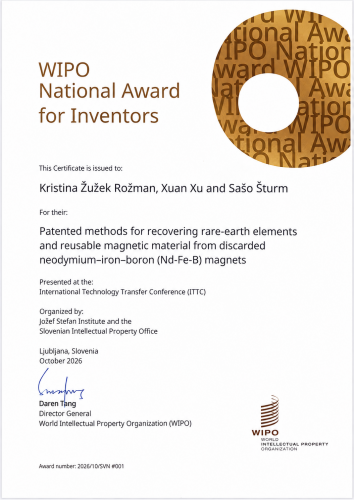
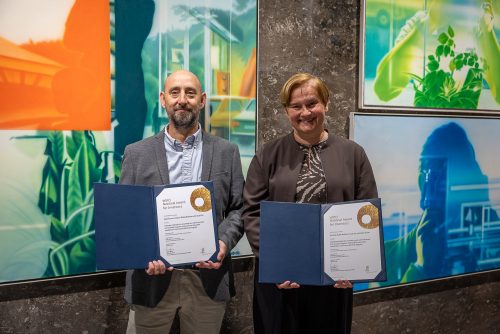
Researchers Xuan Xu, Sašo Šturm and Kristina Žužek (Rožman) from the Jožef Stefan Institute, Department for Nanostructured Materials, received the World Intellectual Property Organization (WIPO) Inventor Award, presented on 9 October in Ljubljana during the 19th International Technology Transfer Conference.
The award recognizes their innovative patented technologies for recycling Nd-Fe-B permanent magnets, enabling the recovery and reuse of critical rare-earth elements. They developed electrochemical methods to recover magnetic grains and selectively extract rare-earth elements from magnet waste.
These technologies contribute to the circular economy, efficient resource use, and sustainable development. Research continues through the GREENE and RecovREE projects, in collaboration with Slovenian and European companies, with a focus on developing resource-efficient, high-performance permanent magnets.
The WIPO award highlights research excellence and the importance of transferring knowledge from JSI to industry.
Dr. Petra Jenuš Belec discusses permanent magnets and their recycling on Radio Slovenia
Dr. Petra Jenuš Belec from the Department for Nanostructured Materials at the Jožef Stefan Institute was a guest on Podobe znanja, a science programme broadcast on ARS, Radio Slovenia. The interview focused on the importance of permanent magnets in modern technologies, challenges related to their production, and opportunities for recycling.
Permanent magnets are essential components of numerous technologies, ranging from electric motors and electric vehicles to wind turbines. With the increasing demand for magnetic materials and growing concerns over the availability of critical raw materials, the development of alternative magnetic materials and efficient recycling strategies is becoming increasingly important.
During the interview, Dr. Jenuš Belec also presented research activities carried out within the European project GENIUS (Greener permanent magnets without or with less critical raw materials), coordinated by Dr. Jenuš Belec. The project focuses on developing more sustainable permanent magnets with reduced or no critical raw material content, with particular emphasis on ferrite-based magnets and their recycling.
These research activities contribute to more efficient resource utilisation, reduced environmental impact, and the transition towards a circular economy in the permanent magnet sector.
Listen to the interview (in Slovenian):
More about the GENIUS project: https://genius-era-min.si/
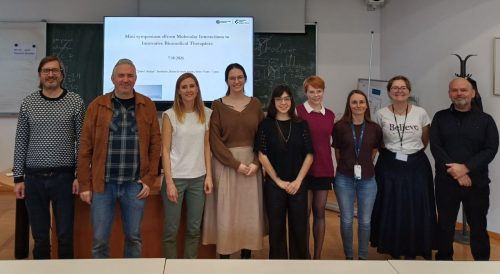
As part of the ARIS J4-70159 project, our department organized a symposium titled “From Molecular Interactions to Innovative Biomedical Therapies” on October 7, 2026, under the leadership of Asst. Prof. Nina Kostevšek. The event featured outstanding speakers from the fields of cell biology, molecular interactions, molecular simulations, and the synthesis of drug delivery systems. Diverse research perspectives sharing a common goal—namely, the development of new therapies—consistently spark interesting discussions and give rise to new ideas.
# ARIS-J4-50150
# Nanostructured materials
# Jožef Stefan Institute
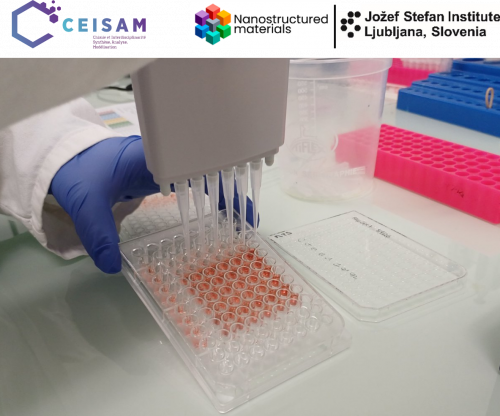
As part of the bilateral Slovenia–France PROTEUS project (BI-FR/25-26-PROTEUS-006) titled “Elucidation of magnetic interactions in nano-assemblies for theranostics applications,” Dr. Nina Kostevšek visited CEISAM (Centre for Education and Research on Advanced Molecular Systems) at the University of Nantes, France.
During the visit, we conducted cellular assays on our new drug delivery system based on cellular vesicles. The initial results are very promising; under the tested conditions, we observed neither cytotoxicity nor an inflammatory response.
This marks a significant step in the development of the system for future theranostic applications.
👏Kudos to the team for their excellent collaboration and successfully conducted experiments!
#PROTEUS #SloveniaFrance #bilateralproject #IJS #CEISAM #UniversityOfNantes #drugdelivery #cellularvesicles #theranostics #biomedicalresearch
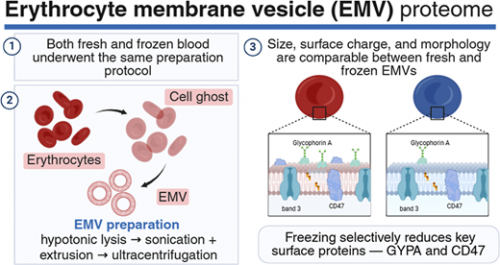
Our latest article from the Nanomedicine group has been published in the Journal of Proteome Research in the scope of ARIS J4-50150 project!
🩸 In this study, we investigated whether erythrocyte membrane vesicles (EMVs) – promising biomimetic nanocarriers for drug delivery – can be produced from frozen blood while preserving their key physicochemical, structural, and protein characteristics.
Using a combination of dynamic light scattering, nano-flow cytometry, cryo-TEM, TEM, and quantitative mass-spectrometry-based proteomics, we compared EMVs prepared from fresh and −80 °C frozen blood.
✨ Key findings:
• EMVs generated from fresh and frozen blood showed broadly comparable size, surface charge, and vesicle morphology.
• Most of the proteome is largely preserved after freezing. Freezing did, however, reduce proteomic complexity and notably affected proteins such as glycophorin A and CD47, which may be important for future applications involving immune interactions and targeted drug delivery.
• Overall, the results indicate that frozen blood can be a viable and practical source for EMV production when immediate processing of fresh blood is not feasible, although further functional studies are needed.
📖 Read the full article:
https://doi.org/10.1021/acs.jproteome.6c00535
#Proteomics #ErythrocyteMembraneVesicles #Nanomedicine #DrugDelivery #BiomimeticNanoparticles #Research #Science #JozefStefanInstitute # ARIS-J4-50150